
Science Fiction
Dictionary
A B C D E F G H I J K L M N O P Q R S T U V W X Y Z

 |
Programmable Lab-On-A-Chip

A programmable lab-on-a-chip (LOC) has been designed at Purdue University. Rather than going through a long and involved process to create single-use devices, researchers have succeeded in creating a much more versatile chip that can perform a wide variety of functions.
LOCs are small and portable; they can be used in the field to perform real-time PCR, detecting and identifying bacteria, viruses and cancers. For example, rather than sending a blood sample to the CDC to test for swine flu, a field agent could make a determination once given the proper characteristics to program into the device.
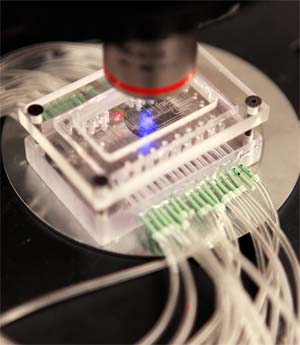
(Programmable lab-on-a-chip from Purdue University)
A Lab-on-a-chip (LOC) is a device that takes very small samples (as little as a pico liter) and performs a laboratory analysis. LOCs are small, ranging in size from a few square millimeters to a few square centimeters.
The term "chip" is used because some of the manufacturing processes derive from those used to fabricate computer chips (integrated circuits). Photolithography techniques derived from semiconductor fabrication are used where needed. LOCs also require extremely small mechanical structures for fluid handling, like tiny capillary connections, mixers, valves pumps and dosing devices.
Team member and doctoral student Han-Sheng Chuang, a student in the School of Mechanical Engineering, has led work to develop hardware for the new programmable chip, creating a single chip that contains a multipurpose arrangement of these components.
The new chip is made out of a rubber-like polymer, called polydimethylsiloxane, instead of the rigid glass or silicon wafers often used. The flexible material is needed because pumps used to direct the flow of fluid operate with moving diaphragms.Most other chips have the polymer layer sandwiched between two glass layers.
"We chose to build the whole chip out of the PDMS polymer, which makes it easier to fabricate and reduces cost over other alternatives, such as silicon or glass," Chuang said.
The Purdue-designed chip is able to mix, store, heat and sense what the sample is made of, whereas previous programmable chips have been limited to mixing and storing samples.
Programmable chips for in-the-field analysis are expected within the next five years.
Readers of popular thriller-level science fiction may recall the Boink biosensor from The Cobra Event, a 1997 novel by Richard Preston, which was ultra-miniaturized - the size of a suitcase.
Hard SF readers may also be familiar with the WAGD germ detector from Greg Bear's Quantico, that was handheld:
...She reached into her coat pocket and pulled out a WAGD, hiding most of it in her palm and up her sleeve, then swiftly uncapped it ... and ran the moist gel tip along the inside... She capped and pocketed the device...
(Read more about the WAGD germ detector)
From Purdue News via MedGadget.
Scroll down for more stories in the same category. (Story submitted 4/30/2009)
Follow this kind of news @Technovelgy.| Email | RSS | Blog It | Stumble | del.icio.us | Digg | Reddit |
Would
you like to contribute a story tip?
It's easy:
Get the URL of the story, and the related sf author, and add
it here.
Comment/Join discussion ( 0 )
Related News Stories - (" Medical ")
3D Printed Organs From Space
'For a while your colonists will have to come up to the [orbital] Hospital...'
Health Kiosk Has No Human Doctor
'The electronic body analyzer had been developed...' - Michael Crichton, 1969.
NEO Brain Computer Interface (BCI)
'The remains of the lace took on the rough shape of a brain...' - Iain Banks, 2010.
MIT Computerized Bionic Leg Is Part Of The User
'The leg was to function, in a way, as a servo-mechanism operated by Larry’s brain, through the mediation of the electronic brain in the leg.' - Charles Recour, 1949.
Technovelgy (that's tech-novel-gee!) is devoted to the creative science inventions and ideas of sf authors. Look for the Invention Category that interests you, the Glossary, the Invention Timeline, or see what's New.

Science Fiction
Timeline
1600-1899
1900-1939
1940's 1950's
1960's 1970's
1980's 1990's
2000's 2010's
Current News
'If Anyone Is Watching Earth...'
'Our study of your race has convinced us that you are not fitted to leave your planet in the present state of your civilization.'
Epirus High-Power Microwave Defeats Drones
'...the spreading beam of the deranging ray struck them, and Then one toppled and fell. Then another.'
Cloud Of Space Rubbish From China's Long March Rocket
'Within seconds the material was spread out over fifty yards, in a matter of hours it might occupy several cubic miles of space...'
Biomimetic Tendons From Rochu Robotics
'... the curious parallelism to animal motions.'
Living Human Neuron Biological Compute Rack
'The men are dead, but their acquired wisdom lives on and I am the beneficiary.'
Martha Stewart Approves Ojai 'Living Room On Wheels'
'Young people found the driverless car admirable for petting.'
ESA's Draco To Study Heat Of Reentry
'...a synthetic which air-friction would erode.'
Buy A Galaxy? Maybe Start Smaller
'The sky is the limit' just got higher.
The United States Space Academy Is Official
'Is our orbit to Space Academy clear?'
Is There A Global Problem With Who Is Having Children?
'After twenty generations of shillyshallying...'
You Will Eat The Cookies Made From Plastic...
'Our planes are going to start bringing in bales of discarded plastics...'
It's A Giant Robot! You Reporters Have Been Warned!
'... completely forgetting the ship at sight of the awesome figure and great head of the giant Gaut...'
Birds Learn To Sing Pictures ala Frank Herbert's Distrans
'We will fight in the time of fighting.'
ElectionSim: China's 'Ender's Game' Battle Sim, Or Lem's 'Kingdom In A Box'?
'So, Ender, we will now begin your education.'
Tactile Skin Supplier Map
'What strange sensitivity! What an amazing development of science was manifested in every move and act and word of this Robot!'
Flock Stymied By 'Adversarial Fashion'
'Forget the head atop it, the legs below, feet, arms, hands. It compels erasure.'

