
Science Fiction
Dictionary
A B C D E F G H I J K L M N O P Q R S T U V W X Y Z

 |
Software Tools Design Anti-Viral Cities

Is it possible to create a computer program that would allow the user to prevent the spread of a viral disease through proper design of cities and their infrastructure? Science fiction writer J.G. Ballard thought so.
In Super-Cannes: A Novel, published in 2000, he wrote about the idea. At one point the book's narrator is speaking with the corporate director of Eden-Olympia, a planned live/work community in southern France. The director refers to medical research that the narrator's own wife, a doctor, has been performing:
As it turns out, there has been work done on this idea. A demonstration project called Dynamical Network Design for Controlling Virus Spread shows the dynamics of the spread of the SARS virus in Hong Kong's eighteen districts if available resources are allocated in different ways:
As an example, epidemic control can be viewed as reducing the average number of secondary infections produced during an infected individual's infectious period. The spatially inhomogeneous dynamics for epidemic spread in a population network are often represented using a class of models known as multi-group models. Using the multi-group model, the authors have posed and solved the problem of inhomogeneously allocating local resources to minimize spread (i.e., secondary infection population).
"She's running a new computer model," the director says, "tracing the spread of nasal viruses across Eden-Olympia. She has a hunch that if people moved their chairs a further eighteen inches apart they'd stop the infectious vectors in their tracks."
Recently, problems of network management and design have become more and more important in such diverse areas as air traffic flow management and virus-spread control. Several problems of interest can be abstracted to the problems of allocating resources to a network based on its graph topology, so as to optimize its dynamic performance.
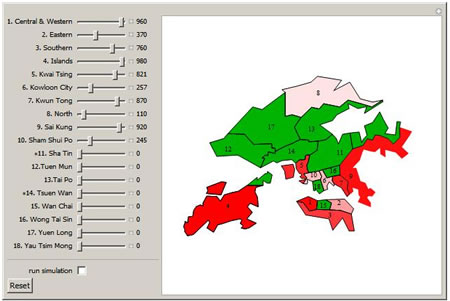
(From Dynamical Network Design for Controlling Virus Spread)
Another similar project is under way at Carnegie Mellon. Ph.D. student Sean Green is working on a set of tools to identify the best way to curb the spread of diarrheal illness in more than 192 countries worldwide. Infrastructure for sanitation is essential; but where do you get the biggest bang for your buck?
"We want to show where the money can be best spent in these communities where diarrheal illness kills more than two million people a year, and remains the third-leading cause of child mortality," said Green, a fourth year Ph.D. student in Carnegie Mellon's Engineering and Public Policy Department.In research supported by the National Science Foundation, the Steinbrenner Institute for Environmental Education and Research and the Heinz Foundation, Green along with Carnegie Mellon professors Mitchell J. Small and Elizabeth A. Casman developed a pattern matching computer tool that uses a set of variables describing information about a country to try to pinpoint which policies are most effective at preventing disease outbreaks.
The Carnegie Mellon researchers report that the most important variable for reducing deadly diarrheal outbreaks among the factors that they considered is improved sanitation in rural areas.
Note: J.G. Ballard died just a couple of weeks ago; he will be missed.
From This Diseased Utopia and Dynamical Network Design for Controlling Virus Spread; see also Carnegie Mellon's Sean Green Uses Combination of Computer Tools And Artificial Intelligence to Predict Diarrheal Illness Globally.
Scroll down for more stories in the same category. (Story submitted 5/3/2009)
Follow this kind of news @Technovelgy.| Email | RSS | Blog It | Stumble | del.icio.us | Digg | Reddit |
Would
you like to contribute a story tip?
It's easy:
Get the URL of the story, and the related sf author, and add
it here.
Comment/Join discussion ( 0 )
Related News Stories - (" Medical ")
3D Printed Organs From Space
'For a while your colonists will have to come up to the [orbital] Hospital...'
Health Kiosk Has No Human Doctor
'The electronic body analyzer had been developed...' - Michael Crichton, 1969.
NEO Brain Computer Interface (BCI)
'The remains of the lace took on the rough shape of a brain...' - Iain Banks, 2010.
MIT Computerized Bionic Leg Is Part Of The User
'The leg was to function, in a way, as a servo-mechanism operated by Larry’s brain, through the mediation of the electronic brain in the leg.' - Charles Recour, 1949.
Technovelgy (that's tech-novel-gee!) is devoted to the creative science inventions and ideas of sf authors. Look for the Invention Category that interests you, the Glossary, the Invention Timeline, or see what's New.

Science Fiction
Timeline
1600-1899
1900-1939
1940's 1950's
1960's 1970's
1980's 1990's
2000's 2010's
Current News
'If Anyone Is Watching Earth...'
'Our study of your race has convinced us that you are not fitted to leave your planet in the present state of your civilization.'
Epirus High-Power Microwave Defeats Drones
'...the spreading beam of the deranging ray struck them, and Then one toppled and fell. Then another.'
Cloud Of Space Rubbish From China's Long March Rocket
'Within seconds the material was spread out over fifty yards, in a matter of hours it might occupy several cubic miles of space...'
Biomimetic Tendons From Rochu Robotics
'... the curious parallelism to animal motions.'
Living Human Neuron Biological Compute Rack
'The men are dead, but their acquired wisdom lives on and I am the beneficiary.'
Martha Stewart Approves Ojai 'Living Room On Wheels'
'Young people found the driverless car admirable for petting.'
ESA's Draco To Study Heat Of Reentry
'...a synthetic which air-friction would erode.'
Buy A Galaxy? Maybe Start Smaller
'The sky is the limit' just got higher.
The United States Space Academy Is Official
'Is our orbit to Space Academy clear?'
Is There A Global Problem With Who Is Having Children?
'After twenty generations of shillyshallying...'
You Will Eat The Cookies Made From Plastic...
'Our planes are going to start bringing in bales of discarded plastics...'
It's A Giant Robot! You Reporters Have Been Warned!
'... completely forgetting the ship at sight of the awesome figure and great head of the giant Gaut...'
Birds Learn To Sing Pictures ala Frank Herbert's Distrans
'We will fight in the time of fighting.'
ElectionSim: China's 'Ender's Game' Battle Sim, Or Lem's 'Kingdom In A Box'?
'So, Ender, we will now begin your education.'
Tactile Skin Supplier Map
'What strange sensitivity! What an amazing development of science was manifested in every move and act and word of this Robot!'
Flock Stymied By 'Adversarial Fashion'
'Forget the head atop it, the legs below, feet, arms, hands. It compels erasure.'

