
Science Fiction
Dictionary
A B C D E F G H I J K L M N O P Q R S T U V W X Y Z

 |
Invisibility Cloaks Get Bigger

Print out big sheets of metamaterials to create real-life invisibility cloaks? A new technique developed by John Rogers, a professor of materials science and engineering at the University of Illinois at Urbana-Champaign, seems to make this possible.
Although practical invisibility cloaks are still in the future, we've been getting close. However, most cloaking devices are too small (see Invisibility Cloaks Seen As Possible With Metamaterials and Invisibility Cloak Fools Naked Eye ), or require the manipulation of spacetime (see Spacetime Cloak Of Invisibility Conceals Events ).
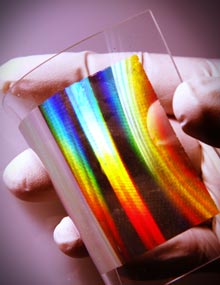
(Largest sheet of metamaterial ever made)
Metamaterials are made up of intricately patterned layers, often of metals. The patterns must be on the same scale as the wavelength of the light they're designed to interact with. In the case of visible and near-infrared light, this means features on the nanoscale. Researchers have been making these materials with such time-consuming methods as electron-beam lithography.Rogers has developed a stamp-based printing method for generating large pieces of one of the most promising types of metamaterial, which can make near-infrared light bend the "wrong" way when it passes through. Materials with this so-called negative index of refraction are particularly promising for making superlenses, night-vision invisibility cloaks, and sophisticated waveguides for telecommunications.
The Illinois group starts by molding a hard plastic stamp that's covered with a raised fishnet pattern. The stamp is then placed in an evaporation chamber and coated with a sacrificial layer, followed by alternating layers of the metamaterial ingredients—silver and magnesium fluoride—to form a layered mesh on the stamp. The stamp is then placed on a sheet of glass or flexible plastic and the sacrificial layer is etched away, transferring the patterned metal to the surface. So far Rogers says he's made metamaterial sheets a few inches per side, but by using more than one stamp he expects to increase that to square feet.
As far as I know, the first reference to an invisibility cloak in science fiction is the invisible cloak from Ray Cummings 1931 classic Brigands of the Moon. Humans have been fascinated by this topic; Greek and Norse mythology have plenty of examples. The first science fiction novel about invisibility is, of course, The Invisible Man, by H.G. Wells in 1897.
Scroll down for more stories in the same category. (Story submitted 6/11/2011)
Follow this kind of news @Technovelgy.| Email | RSS | Blog It | Stumble | del.icio.us | Digg | Reddit |
Would
you like to contribute a story tip?
It's easy:
Get the URL of the story, and the related sf author, and add
it here.
Comment/Join discussion ( 0 )
Related News Stories - (" Material ")
'Mooncrete' Lunar Regolith Concrete (LRC)
'And here they began to build...' - William Gibson, 1988.
Harvard Metamaterials Change Structure Instantly
'Annealed in any shape for a time, and codified, the structure of that shape is retained down to the molecules.' - Samuel R. Delany
Nano-Chainmail 2D Mechanically Interlocked Polymer
'Nemourlon armor of reasonable weight resists penetration by most fragments and any bullet that is not both reasonably heavy and fairly high-velocity.' - Jerry Pournelle, 1976.
Goldene - A Two-Dimensional Sheet Of Gold One Atom Thick
'Hasan always pitched a Gauzy - a one-molecule-layer tent, opaque, feather-light, and very tough.' - Roger Zelazny, 1966.
Technovelgy (that's tech-novel-gee!) is devoted to the creative science inventions and ideas of sf authors. Look for the Invention Category that interests you, the Glossary, the Invention Timeline, or see what's New.

Science Fiction
Timeline
1600-1899
1900-1939
1940's 1950's
1960's 1970's
1980's 1990's
2000's 2010's
Current News
'If Anyone Is Watching Earth...'
'Our study of your race has convinced us that you are not fitted to leave your planet in the present state of your civilization.'
Epirus High-Power Microwave Defeats Drones
'...the spreading beam of the deranging ray struck them, and Then one toppled and fell. Then another.'
Cloud Of Space Rubbish From China's Long March Rocket
'Within seconds the material was spread out over fifty yards, in a matter of hours it might occupy several cubic miles of space...'
Biomimetic Tendons From Rochu Robotics
'... the curious parallelism to animal motions.'
Living Human Neuron Biological Compute Rack
'The men are dead, but their acquired wisdom lives on and I am the beneficiary.'
Martha Stewart Approves Ojai 'Living Room On Wheels'
'Young people found the driverless car admirable for petting.'
ESA's Draco To Study Heat Of Reentry
'...a synthetic which air-friction would erode.'
Buy A Galaxy? Maybe Start Smaller
'The sky is the limit' just got higher.
The United States Space Academy Is Official
'Is our orbit to Space Academy clear?'
Is There A Global Problem With Who Is Having Children?
'After twenty generations of shillyshallying...'
You Will Eat The Cookies Made From Plastic...
'Our planes are going to start bringing in bales of discarded plastics...'
It's A Giant Robot! You Reporters Have Been Warned!
'... completely forgetting the ship at sight of the awesome figure and great head of the giant Gaut...'
Birds Learn To Sing Pictures ala Frank Herbert's Distrans
'We will fight in the time of fighting.'
ElectionSim: China's 'Ender's Game' Battle Sim, Or Lem's 'Kingdom In A Box'?
'So, Ender, we will now begin your education.'
Tactile Skin Supplier Map
'What strange sensitivity! What an amazing development of science was manifested in every move and act and word of this Robot!'
Flock Stymied By 'Adversarial Fashion'
'Forget the head atop it, the legs below, feet, arms, hands. It compels erasure.'

