
Science Fiction
Dictionary
A B C D E F G H I J K L M N O P Q R S T U V W X Y Z

 |
Moran Cerf, When Will We Get Neuro Tech For Ourselves?

MIT's Media Lab had a great streaming talk today by Moran Cerf, a professor of neuroscience and business at the Kellogg School of Management and the neuroscience program at Northwestern university. He also studies patients undergoing brain-surgery to examine behavior, emotion and decision making. This is accomplished by recording the activity of individual nerve cells using electrodes implanted in the patient's brain for clinical purposes.
Twitter users were invited to submit questions; I asked:
"How long will it be until this technology is mature/cheap enough for individual people who want to hack their own minds?" #MLTalks
— Bill Christensen (@Technovelgy) April 23, 2015I was only able to jot down some of his response, so this is paraphrased:
In 2010, a story that I had perfected dream control went viral; I was asked by businesses about it, they. wanted to option it. Even though I don't have it... they still wanted it. And then 4 years it became possible.I think surgery, surgical implantation is the best way. However, I hope to replace this method with non-invasive methods, which are better...
SF stories are next. SF authors can write a script. They tap into millions of minds, we can tell that people have peak engagement. So how does a person sit in office and see what everyone wants?
I agree that prices are going down. However, real knowledge is a problem, but the world is not yet ready. people are not there yet.
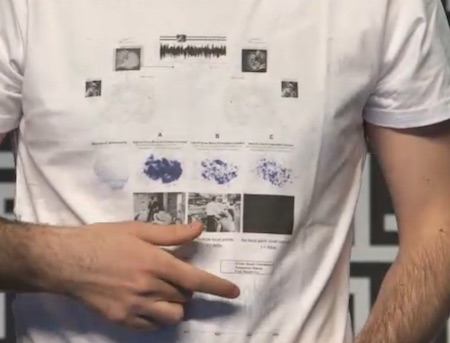
(I also liked his t-shirt)
Science fiction fans have been reading stories that engage them, and stoke their imaginations. In his 1977 novel A Scanner Darkly, Philip K. Dick makes extensive use of the cephalochromoscope, a consumer device used for relaxation:
"Your cephalochromoscope that cost you nine hundred dollars, that you always turn on and play when you get home - Ernie and Barris were babbling away about it. They tried to use it today and it wouldn't work. No colors and no ceph patterns, neither one..."
(Read more about the cephalochromoscope or cephscope)
Note that the root words for cephalo-chromo-scope literally means "brain" - "color" + "watch or see".
SF movie fans may recall the 1983 movie Brainstorm, starring Christopher Walken and Natalie Wood. In the film, a team of scientists creates "The Hat, a special helmet that is able to read sensations from one person's brain and write them to tape so that others are able to experience them.
If brainwave-sensing consumer products tickle your fancy, take a look at the The Hair Brush That Reads Your Mind and the Hitachi Brain Scanner Fun Toy.
More about Moran Cerf; via MIT (I'll update this).
Scroll down for more stories in the same category. (Story submitted 4/23/2015)
Follow this kind of news @Technovelgy.| Email | RSS | Blog It | Stumble | del.icio.us | Digg | Reddit |
Would
you like to contribute a story tip?
It's easy:
Get the URL of the story, and the related sf author, and add
it here.
Comment/Join discussion ( 0 )
Related News Stories - (" Medical ")
Prairie Madness - And Space Sickness
'Space-sickness is one of the most unpleasant sensations that a human being can experience. Not all are subject to it...' - Hugo Gernsback, 1911.
Neuralink Will Allow Humans To Communicate With ... Animals?
'Telepaths had their sensitiveness enlarged to an immense range by the pin-sets, which were telepathic amplifiers adapted to the mammal mind.' - Cordwainer Smith, 1953.
3D Printed Organs From Space
'For a while your colonists will have to come up to the [orbital] Hospital...'
Health Kiosk Has No Human Doctor
'The electronic body analyzer had been developed...' - Michael Crichton, 1969.
Technovelgy (that's tech-novel-gee!) is devoted to the creative science inventions and ideas of sf authors. Look for the Invention Category that interests you, the Glossary, the Invention Timeline, or see what's New.

Science Fiction
Timeline
1600-1899
1900-1939
1940's 1950's
1960's 1970's
1980's 1990's
2000's 2010's
Current News
Prairie Madness - And Space Sickness
'Space-sickness is one of the most unpleasant sensations that a human being can experience. Not all are subject to it...'
Can Stratospheric Aerosol Injection Control The Weather?
'...I saw a nice black heavy-looking cloud sailing by just now, and I can get the electrical machine out in five minutes to draw it down.'
SETI Suggests Prospecting The Solar System Without Landing
'From a distance it could resolve the cosmic rays reflected from various substances.'
Wolfram Alpha Mathematica Predicted by Science Fiction in 1948!
'The answer to the dumb student's prayer.'
Cislunar Space And The Space Lanes of Golden Age Science Fiction
'He had travelled the space-lanes of the solar system for the greater part of his life...'
NASA Moonbase Update
'The dinner was excellent. It was completely vegetarian — grown in specially prepared gardens in this Moon base...'
Neuralink Will Allow Humans To Communicate With ... Animals?
'Telepaths had their sensitiveness enlarged to an immense range by the pin-sets, which were telepathic amplifiers adapted to the mammal mind.'
Special Lights For Driverless Cars!
'That light is actually the Anamorphic Equalizer...'
'Old People Began to Cross The Continent In Their Own Cars'
'It was a relief to enter one of the comfortable autos, whisper a direction down the tube, and just know that you would be taken to your destination in the quickest, safest, and cheapest manner.'
Harrison Bergeron, Illustrated And Practiced
'But he didn't get very far with it before another noise in his ear radio scattered his thoughts. George winced...'
Starfall Manufacturing Drugs In Space
'The vast spinning sphere of Factory in the Sky loomed above and ahead of us, gleaming white against the unfathomable jet depths of surrounding space.'
The Solar Oberth Slingshot
'And if it doesn’t work,' inquired Lazarus, 'what does that make us? Sunspots?'
'Maybe The Woman Of Your Life Is Still Under Production'
'The Dillard people had performed a miracle and put all the works in a girl-modeled case.'
'If Anyone Is Watching Earth...'
'Our study of your race has convinced us that you are not fitted to leave your planet in the present state of your civilization.'
Epirus High-Power Microwave Defeats Drones
'...the spreading beam of the deranging ray struck them, and Then one toppled and fell. Then another.'
Cloud Of Space Rubbish From China's Long March Rocket
'Within seconds the material was spread out over fifty yards, in a matter of hours it might occupy several cubic miles of space...'

