
Science Fiction
Dictionary
A B C D E F G H I J K L M N O P Q R S T U V W X Y Z

 |
Weather As Art

In the aftermath of hurricane Katrina, many of us are wishing that we had some sort of control over the weather. Science fiction writer John Varley even thought about how we might become weather artists in his 1976 novel The Phantom of Kansas. Remarkably, there are real weather artists who try to make what beauty they can from nature's worst storms.
The novel is set on Earth's moon; enormous interior caverns are dug to create vast lunar disneylands, spaces in which Earthlike environments are simulated:
These caverns were big enough to have their own weather, and they did. People who programmed the weather started out with nice days, but eventually started tinkering until the storms and sunsets were good enough to be able to charge admission. One of the best artistic creations was called Cyclone:
In the mid-nineteen seventies, artist Walter de Maria created The Lightning Field near Quemado, New Mexico. It consisted of 400 stainless steel poles averaging just over twenty feet in height. The overall dimensions were 5,280 x 3,300 feet.
The Kansas disneyland was one of the newer ones, and one of the largest. It is a hollowed-out cylinder twenty kilometers beneath Clavius. It measures two hundred and fifty kilometers in diameter and is five kilometers high. The curvature of the floor is consistent with Old Earth so the horizon is terrifyingly far away. Only the gravity is Lunar.
(Read more about the lunar disneyland)
Cyclone has a definite beginning, however. At least to the audience. It begins with the opening bolt of lightning. I worked on it a long time, and designed it to shatter nerves. There is the slow building of thunderheads ... then it hits. It crashes in at seventeen points in a ring around the audience, none further away than a half a kilometer. It is poperly called chain lightning, because after the initial discharge it keeps flashing for a full seven seconds. It's designed to take the hair right off your scalp...
(Read more about this environmental happening)
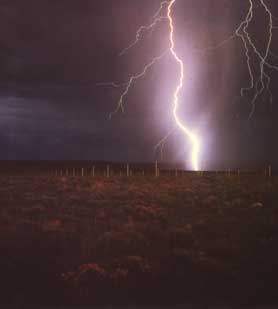
(From The Lightning Field)
Writers sometimes say you should write what you know, advice Varley took to heart with his story. He had a childhood encounter with Hurricane Andrew in Port Arthur, Texas. A category 4 storm, it killed hundreds of people in nearby Louisiana.
The earliest science fiction reference I know about for control of the weather is in John Jacob Astor's 1894 novel A Journey in Other Worlds - people use aeriducts to make rain at will; complete control over all weather is also foreseen. Other more modern references include the weather integrators found in Robert Heinlein's 1940 novel Methuselah's Children and the regular showers in the lunar habitats from Arthur C. Clarke's 1955 novel Earthlight. Human beings have, of course, been trying to figure out how to manipulate the weather since the dawn of recorded history.
Thanks to Blue Monkey for contributing the tips on this story.
Scroll down for more stories in the same category. (Story submitted 9/13/2005)
Follow this kind of news @Technovelgy.| Email | RSS | Blog It | Stumble | del.icio.us | Digg | Reddit |
Would
you like to contribute a story tip?
It's easy:
Get the URL of the story, and the related sf author, and add
it here.
Comment/Join discussion ( 2 )
Related News Stories - (" Culture ")
Buy A Galaxy? Maybe Start Smaller
'The sky is the limit' just got higher.
Is There A Global Problem With Who Is Having Children?
'After twenty generations of shillyshallying...' - CM Kornbluth, 1950.
Warfare Goes Underground In Ukraine
'Once in the very first weeks of the war, before everyone had been evacuated from the surface...' - Philip K. Dick,
The Wind Phone Calls Those Who Have Passed On
'Only I heard that!' - John Brunner, 1975.
Technovelgy (that's tech-novel-gee!) is devoted to the creative science inventions and ideas of sf authors. Look for the Invention Category that interests you, the Glossary, the Invention Timeline, or see what's New.

Science Fiction
Timeline
1600-1899
1900-1939
1940's 1950's
1960's 1970's
1980's 1990's
2000's 2010's
Current News
'If Anyone Is Watching Earth...'
'Our study of your race has convinced us that you are not fitted to leave your planet in the present state of your civilization.'
Epirus High-Power Microwave Defeats Drones
'...the spreading beam of the deranging ray struck them, and Then one toppled and fell. Then another.'
Cloud Of Space Rubbish From China's Long March Rocket
'Within seconds the material was spread out over fifty yards, in a matter of hours it might occupy several cubic miles of space...'
Biomimetic Tendons From Rochu Robotics
'... the curious parallelism to animal motions.'
Living Human Neuron Biological Compute Rack
'The men are dead, but their acquired wisdom lives on and I am the beneficiary.'
Martha Stewart Approves Ojai 'Living Room On Wheels'
'Young people found the driverless car admirable for petting.'
ESA's Draco To Study Heat Of Reentry
'...a synthetic which air-friction would erode.'
Buy A Galaxy? Maybe Start Smaller
'The sky is the limit' just got higher.
The United States Space Academy Is Official
'Is our orbit to Space Academy clear?'
Is There A Global Problem With Who Is Having Children?
'After twenty generations of shillyshallying...'
You Will Eat The Cookies Made From Plastic...
'Our planes are going to start bringing in bales of discarded plastics...'
It's A Giant Robot! You Reporters Have Been Warned!
'... completely forgetting the ship at sight of the awesome figure and great head of the giant Gaut...'
Birds Learn To Sing Pictures ala Frank Herbert's Distrans
'We will fight in the time of fighting.'
ElectionSim: China's 'Ender's Game' Battle Sim, Or Lem's 'Kingdom In A Box'?
'So, Ender, we will now begin your education.'
Tactile Skin Supplier Map
'What strange sensitivity! What an amazing development of science was manifested in every move and act and word of this Robot!'
Flock Stymied By 'Adversarial Fashion'
'Forget the head atop it, the legs below, feet, arms, hands. It compels erasure.'

