
Science Fiction
Dictionary
A B C D E F G H I J K L M N O P Q R S T U V W X Y Z

 |
Asteroid Cleaner Robot To Sweep Up Dust Around The Solar System

Sometimes, space explorers really need to get down to the nitty gritty. As in, analyzing the dusty layers of low-gravity moons or asteroids. The ESA is ready with robots that collect and analyse the surface dust on far-away worlds. As you might imagine, it's tricky - in low gravity a simple drill or scoop would just push the lander away from the surface.
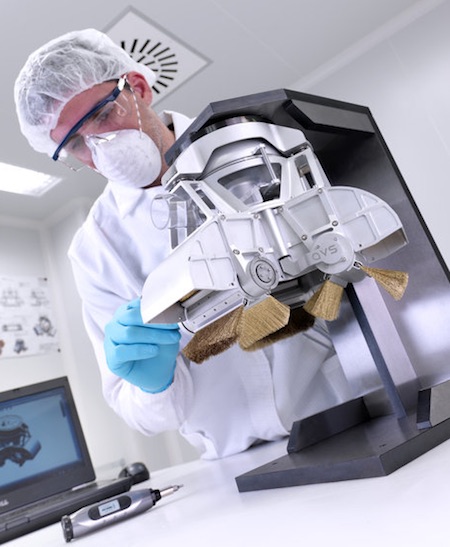
(Asteroid cleaner)
This prototype model uses three rotating brushes that also circle in the horizontal plane to scoop dust into a container for analysis. It is designed to collect at least 100 g within 20 seconds.Designed and built by Added Value Solutions of Spain, the machine automatically detects the distance between the brushes and the surface to adapt as necessary, collect the dust, and direct it into a hermetically sealed box for storage and analysis.
Everything looks promising on Earth, but will it work without gravity? To check it in action, the prototype will fly on ESA’s 64th parabolic aircraft campaign later this month, providing more than 90 bursts of microgravity lasting 20 seconds at a time.
Over the course of three days it will scoop up particles ranging from a few 0.001 mm up to pebbles of 3 cm. The samples can be analysed at the end of each day, and a camera will record progress so that the operators can adjust settings between the bouts of weightlessness.
I confess, of my own free will, that I've never encountered the idea of a asteroid dust-collecting robot in any of the science fiction I've read (if you know of one, ping me @technovelgy).
However, I thought this item was so appealing that I couldn't resist it. And here's a pretty similar idea.
Some readers may be thinking of Project Scoop, from Michael Crichton's 1969 novel The Andromeda Strain.
In theory, JPL was designing a satellite to enter the fringes of space and collect organisms and dust for study. This was considered a project of pure science...In fact, the true aims were quite different. The true aims of Scoop were to find new life forms that might benefit the Fort Detrick program. In essence, it was a study to discover new biological weapons of war.
In the novel, Project Scoop merely orbited the earth, and did not visit other worlds.
Via ESA.
Scroll down for more stories in the same category. (Story submitted 4/8/2016)
Follow this kind of news @Technovelgy.| Email | RSS | Blog It | Stumble | del.icio.us | Digg | Reddit |
Would
you like to contribute a story tip?
It's easy:
Get the URL of the story, and the related sf author, and add
it here.
Comment/Join discussion ( 0 )
Related News Stories - (" Space Tech ")
'If Anyone Is Watching Earth...'
'Our study of your race has convinced us that you are not fitted to leave your planet in the present state of your civilization.' - Arthur C. Clarke, 1946.
Cloud Of Space Rubbish From China's Long March Rocket
'Within seconds the material was spread out over fifty yards, in a matter of hours it might occupy several cubic miles of space...'
ESA's Draco To Study Heat Of Reentry
'...a synthetic which air-friction would erode.' - EE Doc Smith, 1934.
The United States Space Academy Is Official
'Is our orbit to Space Academy clear?' - Carey Rockwell
Technovelgy (that's tech-novel-gee!) is devoted to the creative science inventions and ideas of sf authors. Look for the Invention Category that interests you, the Glossary, the Invention Timeline, or see what's New.

Science Fiction
Timeline
1600-1899
1900-1939
1940's 1950's
1960's 1970's
1980's 1990's
2000's 2010's
Current News
'If Anyone Is Watching Earth...'
'Our study of your race has convinced us that you are not fitted to leave your planet in the present state of your civilization.'
Epirus High-Power Microwave Defeats Drones
'...the spreading beam of the deranging ray struck them, and Then one toppled and fell. Then another.'
Cloud Of Space Rubbish From China's Long March Rocket
'Within seconds the material was spread out over fifty yards, in a matter of hours it might occupy several cubic miles of space...'
Biomimetic Tendons From Rochu Robotics
'... the curious parallelism to animal motions.'
Living Human Neuron Biological Compute Rack
'The men are dead, but their acquired wisdom lives on and I am the beneficiary.'
Martha Stewart Approves Ojai 'Living Room On Wheels'
'Young people found the driverless car admirable for petting.'
ESA's Draco To Study Heat Of Reentry
'...a synthetic which air-friction would erode.'
Buy A Galaxy? Maybe Start Smaller
'The sky is the limit' just got higher.
The United States Space Academy Is Official
'Is our orbit to Space Academy clear?'
Is There A Global Problem With Who Is Having Children?
'After twenty generations of shillyshallying...'
You Will Eat The Cookies Made From Plastic...
'Our planes are going to start bringing in bales of discarded plastics...'
It's A Giant Robot! You Reporters Have Been Warned!
'... completely forgetting the ship at sight of the awesome figure and great head of the giant Gaut...'
Birds Learn To Sing Pictures ala Frank Herbert's Distrans
'We will fight in the time of fighting.'
ElectionSim: China's 'Ender's Game' Battle Sim, Or Lem's 'Kingdom In A Box'?
'So, Ender, we will now begin your education.'
Tactile Skin Supplier Map
'What strange sensitivity! What an amazing development of science was manifested in every move and act and word of this Robot!'
Flock Stymied By 'Adversarial Fashion'
'Forget the head atop it, the legs below, feet, arms, hands. It compels erasure.'

