
Science Fiction
Dictionary
A B C D E F G H I J K L M N O P Q R S T U V W X Y Z

 |
Ancient Ocean On Ceres?

Ceres is the largest object in the asteroid belt that lies between the orbits of Mars and Jupiter. It is approximately 587 miles in diameter and the 33rd largest known body in the solar system.
Is it possible that this small world, a dwarf planet, might have had ancient water oceans in the distant past? NASA's Dawn mission scientists think so.
The Dawn team found that Ceres' crust is a mixture of ice, salts and hydrated materials that were subjected to past and possibly recent geologic activity, and that this crust represents most of that ancient ocean. The second study builds off the first and suggests there is a softer, easily deformable layer beneath Ceres' rigid surface crust, which could be the signature of residual liquid left over from the ocean, too.
"More and more, we are learning that Ceres is a complex, dynamic world that may have hosted a lot of liquid water in the past, and may still have some underground," said Julie Castillo-Rogez, Dawn project scientist and co-author of the studies, based at NASA's Jet Propulsion Laboratory, Pasadena, California.
By modeling how Ceres' crust flows, Fu and colleagues found it is likely a mixture of ice, salts, rock and an additional component believed to be clathrate hydrate. A clathrate hydrate is a cage of water molecules surrounding a gas molecule. This structure is 100 to 1,000 times stronger than water ice, despite having nearly the same density.
The researchers believe Ceres once had more pronounced surface features, but they have smoothed out over time. This type of flattening of mountains and valleys requires a high-strength crust resting on a more deformable layer, which Fu and colleagues interpret to contain a little bit of liquid.
The team thinks most of Ceres' ancient ocean is now frozen and bound up in the crust, remaining in the form of ice, clathrate hydrates and salts. It has mostly been that way for more than 4 billion years. But if there is residual liquid underneath, that ocean is not yet entirely frozen. This is consistent with several thermal evolution models of Ceres published prior to Dawn's arrival there, supporting the idea that Ceres' deeper interior contains liquid left over from its ancient ocean.
Minerals containing water are widespread on Ceres, suggesting the dwarf planet may have had a global ocean in the past. What became of that ocean? Could Ceres still have liquid today? Two new studies from NASA's Dawn mission shed light on these questions.
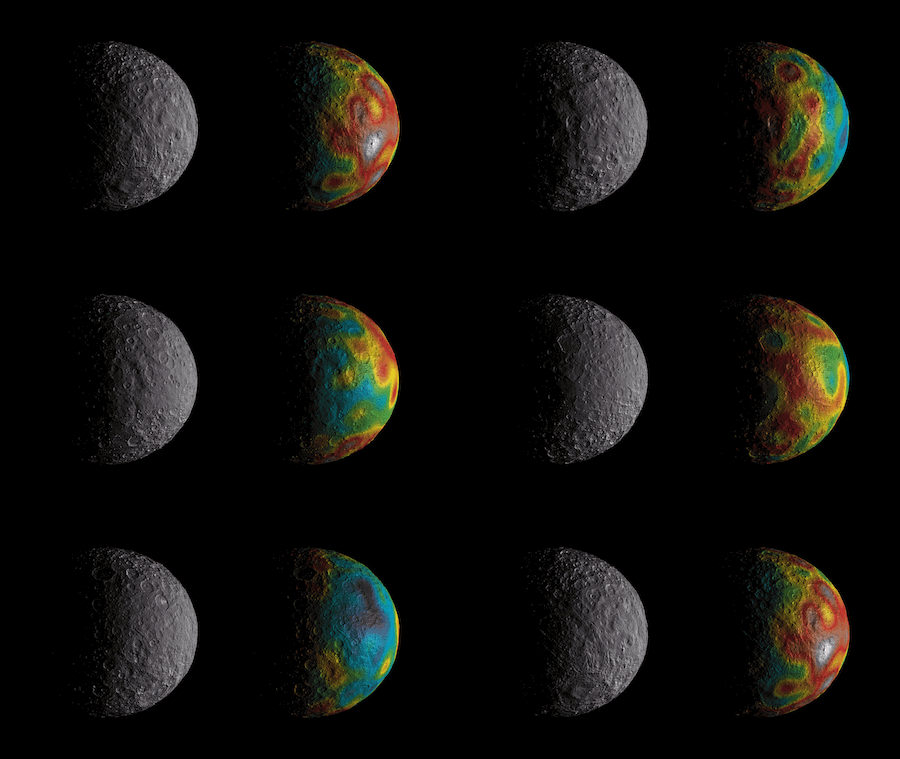
(JPL animation; color map shows structure from gravity measurements)
There are stories from the Golden Age of science fiction that do not recognize all of the realities of life in space that we know so well in the 21st century - in particular, the unlikelihood of small bodies like asteroids with an atmosphere. Now that there might be some evidence for oceans on Ceres, we might need to take a look at some of those lost classics.
One such is the wonderful Brigands of the Moon by Golden Age great Ray Cummings.
Within the hour I had us dropping into the asteroid's atmosphere. The ship heated steadily. The pressure went up. It kept me busy with the instruments and the calculations. But my signals were always promptly answered from below. The brigand crew did its part efficiently.At a hundred and fifty thousand feet I shifted the gravity plates to the landing combinations, and started the electronic engines...
The electronic streams flowed out like a rocket tail behind us. The Planetara caught their impetus. In the rarefied air, our bow lifted slightly, like a ship riding a gentle ground swell. At a hundred thousand feet we sailed gently forward, hull down to the asteroid's surface, cruising to seek a landing space.
A little sea was now beneath us. A shadowed sea, deep purple in the night down there. Occasional verdurous islands showed, with the lines of white surf marking them. Beyond the sea, a curving coastline was visible. Rocky headlines, behind which mountain foothills rose in serrated, verdurous ranks. The sunlight edged the distant mountains; and presently this rapidly turning little world brought the sunlight forward.
It was day beneath us. We slid gently downward. Thirty thousand feet now, above a sparkling blue ocean. The coastline was just ahead; green with a lush, tropical vegetation. Giant trees, huge-leaved. Long, dangling vines; air[102] plants, with giant pods and vivid orchidlike blossoms.
I sat at the turret window, staring through my glasses. A fair, little world, yet obviously uninhabited. I could fancy that all this was newly sprung vegetation. This asteroid had whirled in from the cold of the interplanetary space, far outside our solar system. A few years ago—as time might be measured astronomically, it was no more than yesterday—this fair landscape was congealed white and bleak with a sweep of glacial ice. But the seeds of life miraculously were here. The miracle of life! Under the warming, germinating sunlight, the verdure had sprung.
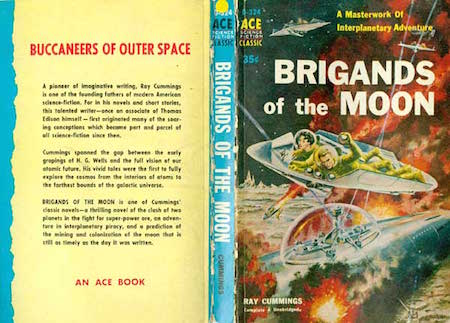
(Brigands of the Moon, 1931)
Via JPL; thanks to Winchell Chung (@nyrath) of Atomic Rockets.
Scroll down for more stories in the same category. (Story submitted 10/30/2017)
Follow this kind of news @Technovelgy.| Email | RSS | Blog It | Stumble | del.icio.us | Digg | Reddit |
Would
you like to contribute a story tip?
It's easy:
Get the URL of the story, and the related sf author, and add
it here.
Comment/Join discussion ( 0 )
Related News Stories - (" Space Tech ")
'If Anyone Is Watching Earth...'
'Our study of your race has convinced us that you are not fitted to leave your planet in the present state of your civilization.' - Arthur C. Clarke, 1946.
Cloud Of Space Rubbish From China's Long March Rocket
'Within seconds the material was spread out over fifty yards, in a matter of hours it might occupy several cubic miles of space...'
ESA's Draco To Study Heat Of Reentry
'...a synthetic which air-friction would erode.' - EE Doc Smith, 1934.
The United States Space Academy Is Official
'Is our orbit to Space Academy clear?' - Carey Rockwell
Technovelgy (that's tech-novel-gee!) is devoted to the creative science inventions and ideas of sf authors. Look for the Invention Category that interests you, the Glossary, the Invention Timeline, or see what's New.

Science Fiction
Timeline
1600-1899
1900-1939
1940's 1950's
1960's 1970's
1980's 1990's
2000's 2010's
Current News
'If Anyone Is Watching Earth...'
'Our study of your race has convinced us that you are not fitted to leave your planet in the present state of your civilization.'
Epirus High-Power Microwave Defeats Drones
'...the spreading beam of the deranging ray struck them, and Then one toppled and fell. Then another.'
Cloud Of Space Rubbish From China's Long March Rocket
'Within seconds the material was spread out over fifty yards, in a matter of hours it might occupy several cubic miles of space...'
Biomimetic Tendons From Rochu Robotics
'... the curious parallelism to animal motions.'
Living Human Neuron Biological Compute Rack
'The men are dead, but their acquired wisdom lives on and I am the beneficiary.'
Martha Stewart Approves Ojai 'Living Room On Wheels'
'Young people found the driverless car admirable for petting.'
ESA's Draco To Study Heat Of Reentry
'...a synthetic which air-friction would erode.'
Buy A Galaxy? Maybe Start Smaller
'The sky is the limit' just got higher.
The United States Space Academy Is Official
'Is our orbit to Space Academy clear?'
Is There A Global Problem With Who Is Having Children?
'After twenty generations of shillyshallying...'
You Will Eat The Cookies Made From Plastic...
'Our planes are going to start bringing in bales of discarded plastics...'
It's A Giant Robot! You Reporters Have Been Warned!
'... completely forgetting the ship at sight of the awesome figure and great head of the giant Gaut...'
Birds Learn To Sing Pictures ala Frank Herbert's Distrans
'We will fight in the time of fighting.'
ElectionSim: China's 'Ender's Game' Battle Sim, Or Lem's 'Kingdom In A Box'?
'So, Ender, we will now begin your education.'
Tactile Skin Supplier Map
'What strange sensitivity! What an amazing development of science was manifested in every move and act and word of this Robot!'
Flock Stymied By 'Adversarial Fashion'
'Forget the head atop it, the legs below, feet, arms, hands. It compels erasure.'

