
Science Fiction
Dictionary
A B C D E F G H I J K L M N O P Q R S T U V W X Y Z

 |
PharmaSat Nano-Satellite Orbiting 'Lab'

PharmaSat and its flight system is an experiment designed to measure the influence of microgravity upon yeast resistance to an antifungal agent. The device is about the size of a loaf of bread; it is a secondary payload on a USAF Minotaur 1 rocket. PharmaSat is completely autonomous, despite its small size - a self-contained orbiting 'lab'.
PharmaSat is intended to accomplish five critical functions in its autonomous free-flyer platform:
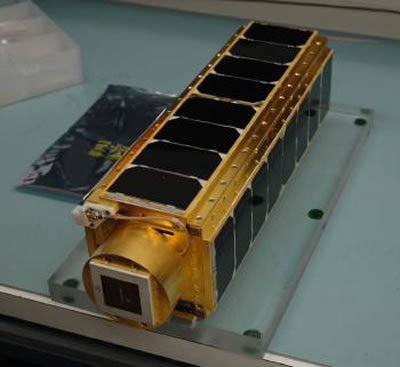
(PharmaSat nano-satellite)
The main technology subsystems include a 3-color optical absorbance system, microfluidic networks, multiple reagent delivery system, and miniature environmental control and power management systems.
"PharmaSat is an important experiment that will yield new information about the susceptibility of microbes to antibiotics in the space environment," said David Niesel, PharmaSat's co-investigator at the University of Texas in Galveston."Secondary payload nanosatellites expand the number of opportunities available to conduct research in microgravity by providing an alternative to the International Space Station or space shuttle conducted investigations," said Elwood Agasid, PharmaSat project manager at NASA's Ames Research Center in Moffett Field, Calif.
The PharmaSat project may remind sf readers of Project Scoop, from Michael Crichton's 1969 novel The Andromeda Strain.
In theory, JPL was designing a satellite to enter the fringes of space and collect organisms and dust for study. This was considered a project of pure science...In fact, the true aims were quite different. The true aims of Scoop were to find new life forms that might benefit the Fort Detrick program. In essence, it was a study to discover new biological weapons of war.
From Space.com and PharmaSat at NASA. Thanks to Winchell Chung
Scroll down for more stories in the same category. (Story submitted 5/9/2009)
Follow this kind of news @Technovelgy.| Email | RSS | Blog It | Stumble | del.icio.us | Digg | Reddit |
Would
you like to contribute a story tip?
It's easy:
Get the URL of the story, and the related sf author, and add
it here.
Comment/Join discussion ( 1 )
Related News Stories - (" Space Tech ")
'If Anyone Is Watching Earth...'
'Our study of your race has convinced us that you are not fitted to leave your planet in the present state of your civilization.' - Arthur C. Clarke, 1946.
Cloud Of Space Rubbish From China's Long March Rocket
'Within seconds the material was spread out over fifty yards, in a matter of hours it might occupy several cubic miles of space...'
ESA's Draco To Study Heat Of Reentry
'...a synthetic which air-friction would erode.' - EE Doc Smith, 1934.
The United States Space Academy Is Official
'Is our orbit to Space Academy clear?' - Carey Rockwell
Technovelgy (that's tech-novel-gee!) is devoted to the creative science inventions and ideas of sf authors. Look for the Invention Category that interests you, the Glossary, the Invention Timeline, or see what's New.

Science Fiction
Timeline
1600-1899
1900-1939
1940's 1950's
1960's 1970's
1980's 1990's
2000's 2010's
Current News
'If Anyone Is Watching Earth...'
'Our study of your race has convinced us that you are not fitted to leave your planet in the present state of your civilization.'
Epirus High-Power Microwave Defeats Drones
'...the spreading beam of the deranging ray struck them, and Then one toppled and fell. Then another.'
Cloud Of Space Rubbish From China's Long March Rocket
'Within seconds the material was spread out over fifty yards, in a matter of hours it might occupy several cubic miles of space...'
Biomimetic Tendons From Rochu Robotics
'... the curious parallelism to animal motions.'
Living Human Neuron Biological Compute Rack
'The men are dead, but their acquired wisdom lives on and I am the beneficiary.'
Martha Stewart Approves Ojai 'Living Room On Wheels'
'Young people found the driverless car admirable for petting.'
ESA's Draco To Study Heat Of Reentry
'...a synthetic which air-friction would erode.'
Buy A Galaxy? Maybe Start Smaller
'The sky is the limit' just got higher.
The United States Space Academy Is Official
'Is our orbit to Space Academy clear?'
Is There A Global Problem With Who Is Having Children?
'After twenty generations of shillyshallying...'
You Will Eat The Cookies Made From Plastic...
'Our planes are going to start bringing in bales of discarded plastics...'
It's A Giant Robot! You Reporters Have Been Warned!
'... completely forgetting the ship at sight of the awesome figure and great head of the giant Gaut...'
Birds Learn To Sing Pictures ala Frank Herbert's Distrans
'We will fight in the time of fighting.'
ElectionSim: China's 'Ender's Game' Battle Sim, Or Lem's 'Kingdom In A Box'?
'So, Ender, we will now begin your education.'
Tactile Skin Supplier Map
'What strange sensitivity! What an amazing development of science was manifested in every move and act and word of this Robot!'
Flock Stymied By 'Adversarial Fashion'
'Forget the head atop it, the legs below, feet, arms, hands. It compels erasure.'

