
Science Fiction
Dictionary
A B C D E F G H I J K L M N O P Q R S T U V W X Y Z

 |
Superconducting Magnetic Bubble To Protect Astronauts From Radiation

Using fields of force to accomplish goals in space is a favorite device of
science fiction authors. In Larry Niven's award-winning 1970 novel Ringworld,
protection against the harsh environmental hazards of space is provided by
a hybrid system
consisting of a General
Products hull and
the Slaver stasis
field. The General Products
hull is an example of a "passive" or material shielding; the hull is transparent
to visible light and impervious to electromagnetic energy and matter in any
form.
The
Slaver
stasis
field creates
an area in which
time
does not pass; since time stands still, no damage can be done to the material
occupying the space protected by the field.
Former astronaut Jeffery Hoffman is proposing a different sort of hybrid system
to protect future astronauts; on long voyages through the solar system they
will
be exposed
to
lethal doses of radiation from cosmic rays. He
has recieved
funding from NASA through NIAC (NASA Institute for Advanced Concepts) to research
the idea of a superconducting magnetic radiation shielding system to supplement
(or replace) traditional passive shielding.
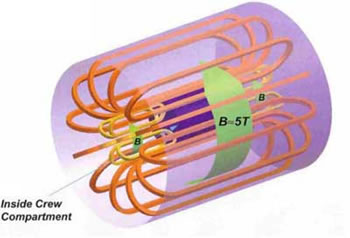
(From Magnetic Bubble)
The idea of using a magnetic field to shield a craft from radiation is not new; as Dr. Hoffman points out "the Earth has been doing it for billions of years!" Using magnetic shielding was proposed in the late 1960's, but not pursued after plans for further space exporation were scrapped.
Two types of radiation need to be addressed, according to William S. Higgins, an engineering physicist who works on radiation safety at Fermilab, the particle accelerator near Chicago, IL:
- Solar flare protons (which would come in bursts following a solar flare)
- Galactic cosmic rays (a continuous background radiation)
Hoffman believes that the best solution may be a hybrid system using both a magnetic field and some passive absorbtion shielding. “That’s the way the Earth does it,” Hoffman explained, “and there’s no reason we shouldn’t be able to do that in space.”
A related experiment, the Alpha Magnetic Spectrometer (AMS), is scheduled to be attached to the outside of the International Space Station and search for different types of cosmic rays. This experiment will be a practical test of maintaining the magnetic field strength and the near-absolute zero temperatures of this kind of system in space.
Phase I research studies the shielding efficiency of the baseline design, and would begin conceptual systems design. Phase II would provide a detailed comparison of magnetic shielding with traditional passive absorption technologies, and detail how to integrate the magnetic shield into a spacecraft.
If you are interested in another NASA proposal that was presaged in science fiction, see NASA's New Radiation Shielding First Proposed By John W. Campbell In 1936. Read more at Magnetic Bubble Could Protect Astronauts and Use of Superconducting Magnet Technology for Astronaut Radiation Protection (pdf).
Scroll down for more stories in the same category. (Story submitted 12/14/2004)
Follow this kind of news @Technovelgy.| Email | RSS | Blog It | Stumble | del.icio.us | Digg | Reddit |
Would
you like to contribute a story tip?
It's easy:
Get the URL of the story, and the related sf author, and add
it here.
Comment/Join discussion ( 2 )
Related News Stories - (" Space Tech ")
'If Anyone Is Watching Earth...'
'Our study of your race has convinced us that you are not fitted to leave your planet in the present state of your civilization.' - Arthur C. Clarke, 1946.
Cloud Of Space Rubbish From China's Long March Rocket
'Within seconds the material was spread out over fifty yards, in a matter of hours it might occupy several cubic miles of space...'
ESA's Draco To Study Heat Of Reentry
'...a synthetic which air-friction would erode.' - EE Doc Smith, 1934.
The United States Space Academy Is Official
'Is our orbit to Space Academy clear?' - Carey Rockwell
Technovelgy (that's tech-novel-gee!) is devoted to the creative science inventions and ideas of sf authors. Look for the Invention Category that interests you, the Glossary, the Invention Timeline, or see what's New.

Science Fiction
Timeline
1600-1899
1900-1939
1940's 1950's
1960's 1970's
1980's 1990's
2000's 2010's
Current News
'If Anyone Is Watching Earth...'
'Our study of your race has convinced us that you are not fitted to leave your planet in the present state of your civilization.'
Epirus High-Power Microwave Defeats Drones
'...the spreading beam of the deranging ray struck them, and Then one toppled and fell. Then another.'
Cloud Of Space Rubbish From China's Long March Rocket
'Within seconds the material was spread out over fifty yards, in a matter of hours it might occupy several cubic miles of space...'
Biomimetic Tendons From Rochu Robotics
'... the curious parallelism to animal motions.'
Living Human Neuron Biological Compute Rack
'The men are dead, but their acquired wisdom lives on and I am the beneficiary.'
Martha Stewart Approves Ojai 'Living Room On Wheels'
'Young people found the driverless car admirable for petting.'
ESA's Draco To Study Heat Of Reentry
'...a synthetic which air-friction would erode.'
Buy A Galaxy? Maybe Start Smaller
'The sky is the limit' just got higher.
The United States Space Academy Is Official
'Is our orbit to Space Academy clear?'
Is There A Global Problem With Who Is Having Children?
'After twenty generations of shillyshallying...'
You Will Eat The Cookies Made From Plastic...
'Our planes are going to start bringing in bales of discarded plastics...'
It's A Giant Robot! You Reporters Have Been Warned!
'... completely forgetting the ship at sight of the awesome figure and great head of the giant Gaut...'
Birds Learn To Sing Pictures ala Frank Herbert's Distrans
'We will fight in the time of fighting.'
ElectionSim: China's 'Ender's Game' Battle Sim, Or Lem's 'Kingdom In A Box'?
'So, Ender, we will now begin your education.'
Tactile Skin Supplier Map
'What strange sensitivity! What an amazing development of science was manifested in every move and act and word of this Robot!'
Flock Stymied By 'Adversarial Fashion'
'Forget the head atop it, the legs below, feet, arms, hands. It compels erasure.'

