
Science Fiction
Dictionary
A B C D E F G H I J K L M N O P Q R S T U V W X Y Z

 |
Earth To Mars In A Month With Painted Solar Sail

Gregory Benford, professor of physics at UC Irvine (and noted science fiction author) believes that a spacecraft powered by a special kind of solar sail could reach Mars in just one month.
Dr. Benford and his brother James were testing a very thin carbon-mesh sail, using microwaves as the energy source for propulsion. Unexpectedly, the sail experienced a force considerably greater than predicted. They theorized that the heat from the microwave beam was causing carbon monoxide gas to escape from the sail's surface; the recoil from the escaping molecules provided what could be a useful adjunct to the propulsive force experienced by light sails.
They believe that by beaming microwave energy up from Earth to boil off volatile molecules from a specially formulated paint applied to the sail will provide enough added force to propel a spacecraft to Mars in record time. "It's a different way of thinking about propulsion," Gregory Benford says. "We leave the engine on the ground." Their research will be published this month in the journal Acta Astronautica.
(From Carbon sail lifting against gravity under 5 kW microwave beam illumination.)
This is how it would work: a rocket would take the craft to low-Earth orbit, whereupon the craft would unfurl a 100 meter diameter sail. A transmitter on Earth would fire a one-hour burst of microwaves at it to heat it up, accelerating the craft to 60 kilometres per second. This would set an interplanetary speed record for space probes.
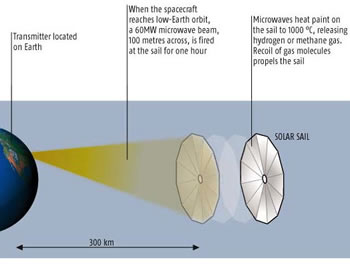
(From At 21,000 Km/hr, Mars is close.)
However, more work is needed to make this possible. The plan would require a 60-megawatt microwave beam with a similar diameter as the sail that was capable of tracking the craft. The deep-space communications network that NASA uses to communicate with Mars rovers and the Cassini probe now orbiting Saturn can only output half a megawatt.
If this design could work, it would make significant progress in the use of ground-based beam-propulsion designs. As science fiction readers know, this topic was explored in the 1974 novel Mote in God's Eye by Larry Niven and Jerry Pournelle. They used the idea of laser cannon from Robert L. Forward's 1961 paper Ground-Based Lasers For Propulsion In Space to bring an alien spacecraft to our solar system. Readers may also wish to explore early sf looks at solar sails.
Read a bit more about Gregory Benford; the article First Flight By A Laser-Powered Airplane chronicles an earlier effort at ground-based propulsion. See also Solar super-sail could reach Mars in a month and Acceleration of Sails by Thermal Desorption of Coatings (pdf).
Scroll down for more stories in the same category. (Story submitted 2/9/2005)
Follow this kind of news @Technovelgy.| Email | RSS | Blog It | Stumble | del.icio.us | Digg | Reddit |
Would
you like to contribute a story tip?
It's easy:
Get the URL of the story, and the related sf author, and add
it here.
Comment/Join discussion ( 9 )
Related News Stories - (" Space Tech ")
'If Anyone Is Watching Earth...'
'Our study of your race has convinced us that you are not fitted to leave your planet in the present state of your civilization.' - Arthur C. Clarke, 1946.
Cloud Of Space Rubbish From China's Long March Rocket
'Within seconds the material was spread out over fifty yards, in a matter of hours it might occupy several cubic miles of space...'
ESA's Draco To Study Heat Of Reentry
'...a synthetic which air-friction would erode.' - EE Doc Smith, 1934.
The United States Space Academy Is Official
'Is our orbit to Space Academy clear?' - Carey Rockwell
Technovelgy (that's tech-novel-gee!) is devoted to the creative science inventions and ideas of sf authors. Look for the Invention Category that interests you, the Glossary, the Invention Timeline, or see what's New.

Science Fiction
Timeline
1600-1899
1900-1939
1940's 1950's
1960's 1970's
1980's 1990's
2000's 2010's
Current News
'If Anyone Is Watching Earth...'
'Our study of your race has convinced us that you are not fitted to leave your planet in the present state of your civilization.'
Epirus High-Power Microwave Defeats Drones
'...the spreading beam of the deranging ray struck them, and Then one toppled and fell. Then another.'
Cloud Of Space Rubbish From China's Long March Rocket
'Within seconds the material was spread out over fifty yards, in a matter of hours it might occupy several cubic miles of space...'
Biomimetic Tendons From Rochu Robotics
'... the curious parallelism to animal motions.'
Living Human Neuron Biological Compute Rack
'The men are dead, but their acquired wisdom lives on and I am the beneficiary.'
Martha Stewart Approves Ojai 'Living Room On Wheels'
'Young people found the driverless car admirable for petting.'
ESA's Draco To Study Heat Of Reentry
'...a synthetic which air-friction would erode.'
Buy A Galaxy? Maybe Start Smaller
'The sky is the limit' just got higher.
The United States Space Academy Is Official
'Is our orbit to Space Academy clear?'
Is There A Global Problem With Who Is Having Children?
'After twenty generations of shillyshallying...'
You Will Eat The Cookies Made From Plastic...
'Our planes are going to start bringing in bales of discarded plastics...'
It's A Giant Robot! You Reporters Have Been Warned!
'... completely forgetting the ship at sight of the awesome figure and great head of the giant Gaut...'
Birds Learn To Sing Pictures ala Frank Herbert's Distrans
'We will fight in the time of fighting.'
ElectionSim: China's 'Ender's Game' Battle Sim, Or Lem's 'Kingdom In A Box'?
'So, Ender, we will now begin your education.'
Tactile Skin Supplier Map
'What strange sensitivity! What an amazing development of science was manifested in every move and act and word of this Robot!'
Flock Stymied By 'Adversarial Fashion'
'Forget the head atop it, the legs below, feet, arms, hands. It compels erasure.'

