
Science Fiction
Dictionary
A B C D E F G H I J K L M N O P Q R S T U V W X Y Z

 |
We Live In A Space Cloud

According to the latest data from IBEX (Interstellar Boundary Explorer, or IBEX), we are slowly traveling through a thin cloud of interstellar material, but are close to the boundaries. IBEX’s measurements of interstellar hydrogen, oxygen, and neon are the first–ever detections of these atoms by any spacecraft.
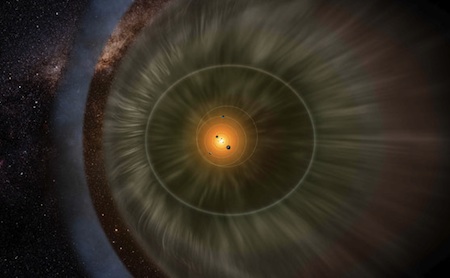
(An artist’s rendition of a portion of our heliosphere
with the solar wind streaming out past the planets and forming a boundary as it interacts with the material between the stars.)
Our entire heliosphere, which contains our Sun, the planets, and everything else in our Solar System, is moving through the interstellar medium. Because of this motion, a sort–of "breeze" of interstellar material moves toward our heliosphere’s boundary. The interstellar neutral atoms are just that – "neutral" – meaning they do not interact with magnetic fields. ISNs [interstellar neutral atoms] move through the boundary of our heliosphere without the boundary affecting them...There appears to be a network of gas and dust clouds in our local galactic vicinity. While very dilute and thin, the general positions of these clouds can still be measured. As our heliosphere (and everything in it) orbits the center of our galaxy, we pass into and out of these clouds at various times...
Based on Ulysses results, previous science teams had concluded that our heliosphere was located in between two of the nearby clouds, the "Local Cloud" and the "G-Cloud" and transitioning into a new region of space. However, while the boundary of the Local Cloud is very close, IBEX results show the heliosphere remains fully in the Local Cloud, at least for the moment. "Sometime in the next hundred to few thousand years, the blink of an eye on the timescales of the galaxy, our heliosphere should leave the local interstellar cloud and encounter a much different galactic environment," Dave McComas [IBEX Principal Investigator] says.
Astronomer Fred Hoyle wrote about interstellar clouds encompassing the Earth in his 1957 novel Black Cloud. In the story, an astronomy grad student named Knut Jensen was going about the rather prosaic work of looking for supernovae. In the 1950's, the best way to do this was to take a picture of a patch of sky, and then take another picture a month or so later. The two pictures (or photographic plates) were placed side-by-side in a device called a "blink comparator" (called a 'blinker' in the story). By glancing first at one and then the other, any stars that suddenly become brighter are easily seen.
In a rich star field was a large, almost exactly circular, dark patch.
Further study demonstrated that this cloud was moving directly toward the sun, and that it appeared to demonstrate intelligence. Scientists puzzled over how an intelligent entity could control an enormous gaseous nebula, and decided that it must be done through the manipulation of magnetic fields within the cloud of gas:
"I imagine that the beast orders the material of the cloud magnetically, that by means of magnetic fields he can move materials wherever he wants inside the cloud."
(Read more about magnetic control of nebulae)

(Earth menaced by a power beyond the planets and older than time!)
Similar space clouds have menaced Earth in novels like "Exit Earth" by Martin Caidin and in the short story "Transience" by Arthur C. Clarke.
Update 10-Apr-2022: The earliest reference to this idea that I know about is the poison space cloud in The Poison Belt, a 1913 novella by Arthur Conan Doyle:
"You will conceive a bunch of grapes," said he, "which are covered by some infinitesimal but noxious bacillus. The gardener passes it through a disinfecting medium. It may be that he desires his grapes to be cleaner. It may be that he needs space to breed some fresh bacillus less noxious than the last. He dips it into the poison and they are gone. Our Gardener is, in my opinion, about to dip the solar system, and the human bacillus will in an instant be sterilized out of existence."
End update.
Via the IBEX website.
Scroll down for more stories in the same category. (Story submitted 2/4/2012)
Follow this kind of news @Technovelgy.| Email | RSS | Blog It | Stumble | del.icio.us | Digg | Reddit |
Would
you like to contribute a story tip?
It's easy:
Get the URL of the story, and the related sf author, and add
it here.
Comment/Join discussion ( 2 )
Related News Stories - (" Space Tech ")
'If Anyone Is Watching Earth...'
'Our study of your race has convinced us that you are not fitted to leave your planet in the present state of your civilization.' - Arthur C. Clarke, 1946.
Cloud Of Space Rubbish From China's Long March Rocket
'Within seconds the material was spread out over fifty yards, in a matter of hours it might occupy several cubic miles of space...'
ESA's Draco To Study Heat Of Reentry
'...a synthetic which air-friction would erode.' - EE Doc Smith, 1934.
The United States Space Academy Is Official
'Is our orbit to Space Academy clear?' - Carey Rockwell
Technovelgy (that's tech-novel-gee!) is devoted to the creative science inventions and ideas of sf authors. Look for the Invention Category that interests you, the Glossary, the Invention Timeline, or see what's New.

Science Fiction
Timeline
1600-1899
1900-1939
1940's 1950's
1960's 1970's
1980's 1990's
2000's 2010's
Current News
'If Anyone Is Watching Earth...'
'Our study of your race has convinced us that you are not fitted to leave your planet in the present state of your civilization.'
Epirus High-Power Microwave Defeats Drones
'...the spreading beam of the deranging ray struck them, and Then one toppled and fell. Then another.'
Cloud Of Space Rubbish From China's Long March Rocket
'Within seconds the material was spread out over fifty yards, in a matter of hours it might occupy several cubic miles of space...'
Biomimetic Tendons From Rochu Robotics
'... the curious parallelism to animal motions.'
Living Human Neuron Biological Compute Rack
'The men are dead, but their acquired wisdom lives on and I am the beneficiary.'
Martha Stewart Approves Ojai 'Living Room On Wheels'
'Young people found the driverless car admirable for petting.'
ESA's Draco To Study Heat Of Reentry
'...a synthetic which air-friction would erode.'
Buy A Galaxy? Maybe Start Smaller
'The sky is the limit' just got higher.
The United States Space Academy Is Official
'Is our orbit to Space Academy clear?'
Is There A Global Problem With Who Is Having Children?
'After twenty generations of shillyshallying...'
You Will Eat The Cookies Made From Plastic...
'Our planes are going to start bringing in bales of discarded plastics...'
It's A Giant Robot! You Reporters Have Been Warned!
'... completely forgetting the ship at sight of the awesome figure and great head of the giant Gaut...'
Birds Learn To Sing Pictures ala Frank Herbert's Distrans
'We will fight in the time of fighting.'
ElectionSim: China's 'Ender's Game' Battle Sim, Or Lem's 'Kingdom In A Box'?
'So, Ender, we will now begin your education.'
Tactile Skin Supplier Map
'What strange sensitivity! What an amazing development of science was manifested in every move and act and word of this Robot!'
Flock Stymied By 'Adversarial Fashion'
'Forget the head atop it, the legs below, feet, arms, hands. It compels erasure.'

