
Science Fiction
Dictionary
A B C D E F G H I J K L M N O P Q R S T U V W X Y Z

 |
Stellar Navigation Based On Network Analysis

Take a look at this wonderful article on trying to visualize how to travel between the stars. What would a travel network look like?
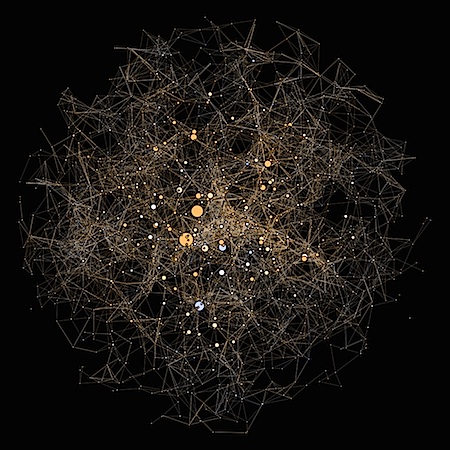
(2D visualization of a 12 light-year network)
With this spirit of exploration in mind I wondered to myself how, exactly, would one go about navigating the stars. Perhaps due to my being older and wiser (and/or losing my childhood imagination), my fantasies regarding exploring the universe now come attached to limitations and practicalities. Stellar travel is beyond our technical abilities; what with our inability to wield space-time, finite life-spans, and technical inabilities and all. But if we could manage even a relatively modest amount of stellar travel, what would that modest amount have to be to open the network of our stellar neighborhood to us? And what would that 3-dimensional network look like?So, I imagined our Sun surrounded by its immediate neighborhood and saw a network of pathways one could take given a limit on how far you could travel before having to "refuel" at the next star system--say, perhaps, via mining asteroids or by deploying your solar charger.
Of the many novels I've read, I was reminded of the network of travel stations in Clifford Simak's 1963 classic Way Station:
Ulysses said, "We are a traveling people. We need a travel station here. We want to turn this house into a station and you to keep the station..."But traveling..."
"From star to star," said Ulysses. "Quicker than the thought of it... It will be no more than a switching and a resting point..."
(Eight Light-year Internal Visualization)
One challenge in accurately visualizing this data is that it has 3 spatial dimensions. Every graph/network visualization I've done before either didn't have spatial dimensions or merely had 2D geo-spatial dimensions. This is a challenge because most graph tools are oriented towards a 2-dimensional layout and visualization. Gephi, a tool I commonly use, does 2-dimensional visualizations. It is aware of 3D coordinates of nodes and can do an okay job of representing it in 2-dimensions. But with no ability to pan, it's hard to get a real feel for what the 3D structure of the network looks like.After some hunting, I found NAViGaTOR which was created and is actively maintained by the Jurisica Lab of the Ontario Cancer Institute. Although it has the ability to do 3D layouts, none of its layouts support coordinate-based layouts from node data. However, after some experimentation, I discovered that if you disable the option which automatically applies a layout on network load, that the default behavior is actually to lay the network out based on node 3D coordinate data. I contacted a maintainer of NAViGaTOR and they confirmed that that is indeed the expected behavior.
I maintained the node coloring based on star temperature above. However, I made every node have equal size.
Fans of 'Doc' Smith's 1934 novel Triplanetary may be reminded of the 3D Tank Display:
Every space-ship within range of her powerful detectors was represented by two brilliant, slowly moving points of light; one upon a great micrometer screen, the other in the "tank"--the immense, three-dimensional, minutely cubed model of the entire Solar System.
Be sure to read the entire article Stellar Navigation Using Network Analysis.
Scroll down for more stories in the same category. (Story submitted 12/8/2014)
Follow this kind of news @Technovelgy.| Email | RSS | Blog It | Stumble | del.icio.us | Digg | Reddit |
Would
you like to contribute a story tip?
It's easy:
Get the URL of the story, and the related sf author, and add
it here.
Comment/Join discussion ( 0 )
Related News Stories - (" Space Tech ")
'If Anyone Is Watching Earth...'
'Our study of your race has convinced us that you are not fitted to leave your planet in the present state of your civilization.' - Arthur C. Clarke, 1946.
Cloud Of Space Rubbish From China's Long March Rocket
'Within seconds the material was spread out over fifty yards, in a matter of hours it might occupy several cubic miles of space...'
ESA's Draco To Study Heat Of Reentry
'...a synthetic which air-friction would erode.' - EE Doc Smith, 1934.
The United States Space Academy Is Official
'Is our orbit to Space Academy clear?' - Carey Rockwell
Technovelgy (that's tech-novel-gee!) is devoted to the creative science inventions and ideas of sf authors. Look for the Invention Category that interests you, the Glossary, the Invention Timeline, or see what's New.

Science Fiction
Timeline
1600-1899
1900-1939
1940's 1950's
1960's 1970's
1980's 1990's
2000's 2010's
Current News
'If Anyone Is Watching Earth...'
'Our study of your race has convinced us that you are not fitted to leave your planet in the present state of your civilization.'
Epirus High-Power Microwave Defeats Drones
'...the spreading beam of the deranging ray struck them, and Then one toppled and fell. Then another.'
Cloud Of Space Rubbish From China's Long March Rocket
'Within seconds the material was spread out over fifty yards, in a matter of hours it might occupy several cubic miles of space...'
Biomimetic Tendons From Rochu Robotics
'... the curious parallelism to animal motions.'
Living Human Neuron Biological Compute Rack
'The men are dead, but their acquired wisdom lives on and I am the beneficiary.'
Martha Stewart Approves Ojai 'Living Room On Wheels'
'Young people found the driverless car admirable for petting.'
ESA's Draco To Study Heat Of Reentry
'...a synthetic which air-friction would erode.'
Buy A Galaxy? Maybe Start Smaller
'The sky is the limit' just got higher.
The United States Space Academy Is Official
'Is our orbit to Space Academy clear?'
Is There A Global Problem With Who Is Having Children?
'After twenty generations of shillyshallying...'
You Will Eat The Cookies Made From Plastic...
'Our planes are going to start bringing in bales of discarded plastics...'
It's A Giant Robot! You Reporters Have Been Warned!
'... completely forgetting the ship at sight of the awesome figure and great head of the giant Gaut...'
Birds Learn To Sing Pictures ala Frank Herbert's Distrans
'We will fight in the time of fighting.'
ElectionSim: China's 'Ender's Game' Battle Sim, Or Lem's 'Kingdom In A Box'?
'So, Ender, we will now begin your education.'
Tactile Skin Supplier Map
'What strange sensitivity! What an amazing development of science was manifested in every move and act and word of this Robot!'
Flock Stymied By 'Adversarial Fashion'
'Forget the head atop it, the legs below, feet, arms, hands. It compels erasure.'

