
Science Fiction
Dictionary
A B C D E F G H I J K L M N O P Q R S T U V W X Y Z

 |
Second Skin Clothing By Biologic Changes With You

Biologic is a project from MIT Media Lab’s Tangible Media Group that seeks to power inert objects using microorganisms.
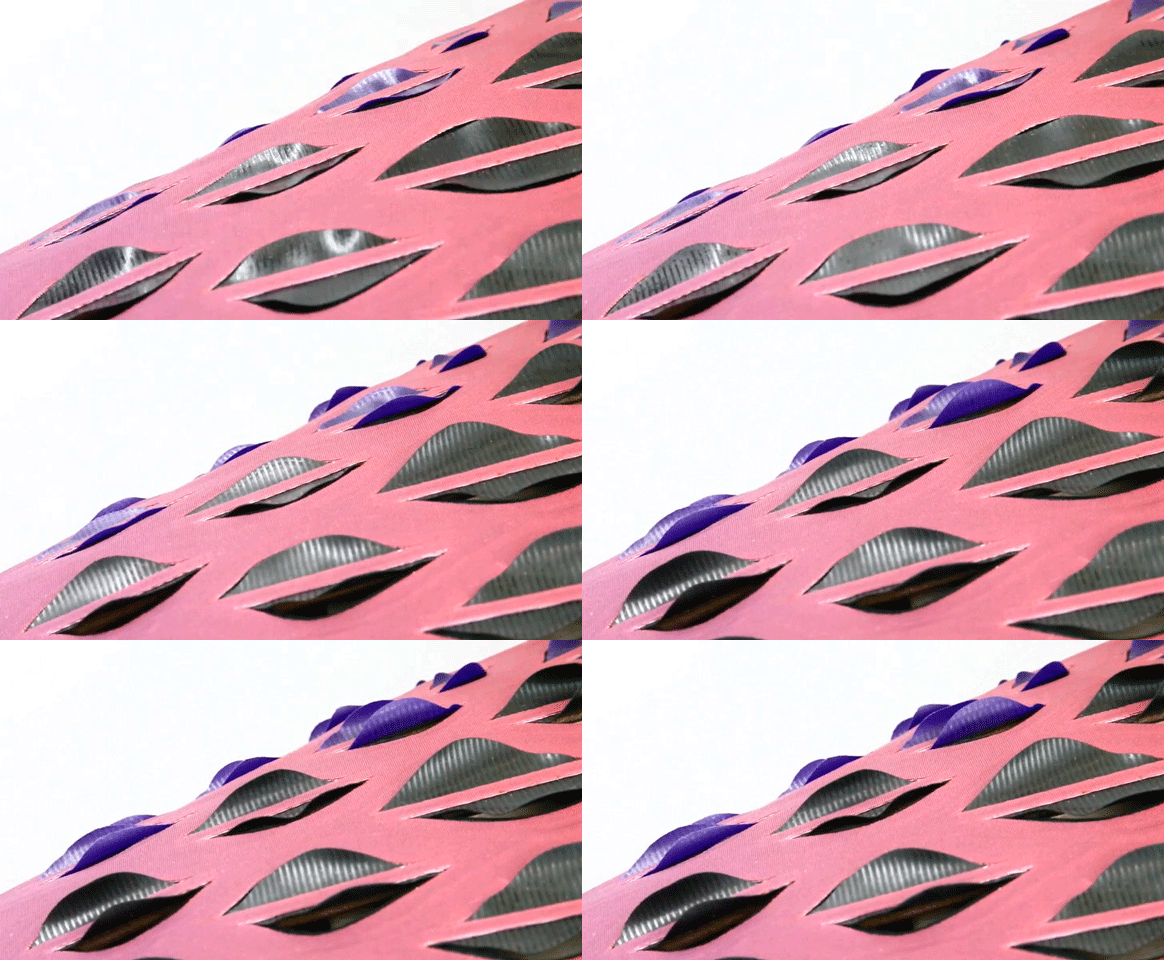
(Biologic illustrated)
The investigation, led by Lining Yao of MIT, focuses on how we can grow actuators that control the interfaces around us instead of manufacturing them in a factory. In other words: Yao and her team want to use the natural behavior of certain microorganisms to power objects and interfaces, the same way a motor might.To power its inventions, BioLogic relies on Bacillus subtilis natto—a bacterium, commonly used in Japanese cooking, that reacts to atmospheric moisture. Like pinecones, these hydromorphic “natto cells” will expand and contract depending on the amount of humidity in the air—the more humidity present, the bigger the bacteria get (the size of an individual cell can change up to 50 percent). With this behavior in mind, Yao partnered with New Balance and designers from the Royal College of Art to create a new type of clothing called Second Skin that becomes more breathable as the wearer’s body heat and humidity increase.
Fans of science fiction may recall the biofabrics from J.G. Ballard's 1970 short story Say Goodbye to the Wind:
The racks of gowns itched and quivered, their colors running into blurred pools. One drawback of bio-fabrics is their extreme sensitivity. Bred originally from the gene stocks of delicate wisterias and mimosas, the woven yard have brought with them something of the vine's remarkable response to atmosphere and touch. The sudden movement of someone nearby, let alone of the wearer, brings an immediate reply from the nerve-like tissues. A dress can change its color and texture in a few seconds, becoming more decollete at the approach of an eager admirer, more formal at a chance meeting with a bank manager.This sensitivity to mood explains the real popularity of bio-fabrics. Clothes are no longer made from dead fibers of fixed color and texture that can approximate only crudely to the vagrant human figure, but from living tissues that adapt themselves to the contours and personality of the wearer. Other advantages are the continued growth of the materials, fed by the body odours and perspriration of the wearer, the sweet liqueurs distilled from her own pores, and the constant renewal of the fibers, repairing any faults or ladders and eliminating the need for washing.
Be sure to check out Ballard's related term inert-wear.
Via Wired; see also MIT Media Lab’s Tangible Media Group BioLogic .
Scroll down for more stories in the same category. (Story submitted 10/20/2015)
Follow this kind of news @Technovelgy.| Email | RSS | Blog It | Stumble | del.icio.us | Digg | Reddit |
Would
you like to contribute a story tip?
It's easy:
Get the URL of the story, and the related sf author, and add
it here.
Comment/Join discussion ( 0 )
Related News Stories - (" Clothing ")
Don't Want To Wear A TIght Shiny Bodysuit?
'He looked a good bit like an elderly, fat beetle.' - Robert Heinlein, 1942.
'Soft Assembly' Fashions That Fashion Themselves On The Wearer
'Clothes are no longer made from dead fibers of fixed color and texture that can approximate only crudely to the vagrant human figure...' - JG Ballard, 1970.
Rigid Metallic Clothing From Science Fiction To You
'...support the interior human structure against Jupiter’s pull.' - Edmond Hamilton, 1932.
iPhone Pocket All Sold Out!
'A long, strong, slender net...' - Margaret St. Clair, 1949.
Technovelgy (that's tech-novel-gee!) is devoted to the creative science inventions and ideas of sf authors. Look for the Invention Category that interests you, the Glossary, the Invention Timeline, or see what's New.

Science Fiction
Timeline
1600-1899
1900-1939
1940's 1950's
1960's 1970's
1980's 1990's
2000's 2010's
Current News
'If Anyone Is Watching Earth...'
'Our study of your race has convinced us that you are not fitted to leave your planet in the present state of your civilization.'
Epirus High-Power Microwave Defeats Drones
'...the spreading beam of the deranging ray struck them, and Then one toppled and fell. Then another.'
Cloud Of Space Rubbish From China's Long March Rocket
'Within seconds the material was spread out over fifty yards, in a matter of hours it might occupy several cubic miles of space...'
Biomimetic Tendons From Rochu Robotics
'... the curious parallelism to animal motions.'
Living Human Neuron Biological Compute Rack
'The men are dead, but their acquired wisdom lives on and I am the beneficiary.'
Martha Stewart Approves Ojai 'Living Room On Wheels'
'Young people found the driverless car admirable for petting.'
ESA's Draco To Study Heat Of Reentry
'...a synthetic which air-friction would erode.'
Buy A Galaxy? Maybe Start Smaller
'The sky is the limit' just got higher.
The United States Space Academy Is Official
'Is our orbit to Space Academy clear?'
Is There A Global Problem With Who Is Having Children?
'After twenty generations of shillyshallying...'
You Will Eat The Cookies Made From Plastic...
'Our planes are going to start bringing in bales of discarded plastics...'
It's A Giant Robot! You Reporters Have Been Warned!
'... completely forgetting the ship at sight of the awesome figure and great head of the giant Gaut...'
Birds Learn To Sing Pictures ala Frank Herbert's Distrans
'We will fight in the time of fighting.'
ElectionSim: China's 'Ender's Game' Battle Sim, Or Lem's 'Kingdom In A Box'?
'So, Ender, we will now begin your education.'
Tactile Skin Supplier Map
'What strange sensitivity! What an amazing development of science was manifested in every move and act and word of this Robot!'
Flock Stymied By 'Adversarial Fashion'
'Forget the head atop it, the legs below, feet, arms, hands. It compels erasure.'

