
Science Fiction
Dictionary
A B C D E F G H I J K L M N O P Q R S T U V W X Y Z

 |
Neuralink Will Land A Chip In Your Brain

Elon Musk gave his long-awaited update to the Neuralink project yesterday. This short video sums it up.
But the central feature is still Neuralink's custom chip designed to identify and transmit patterns of neural activity. Individual neurons, which the electrodes will be listening in on, communicate by firing off a series of what are called "spikes"—short bursts of electrical activity that stand out from the background noise. Musk said that Neuralink's chip comes programmed with a set of spike templates that match the usual range of behaviors seen in actual neurons. The chip will take the analog electrical activity recorded by the electrodes, convert it to digital data, identify any spikes of activity, and then find the template spike that matches the activity best.That allows it to transmit a code that identifies the template, making for a huge compression compared to the complicated, noisy neural activity. It's absolutely necessary for a device that will be communicating via a low-bandwidth interface like Bluetooth.
Neuralink had gotten a Breakthrough Device designation from the Food and Drug Agency, which handles medical-implant approval. That enables the company to engage in an ongoing dialog with the FDA, which will help it identify the sorts of data it will need to gather in order if Neuralink wants to make sure approval is ultimately granted.
(Via ArsTechnica)
Musk has stated that his inspiration for Neuralink comes from science fiction, specifically the idea of a neural lace from Iain M. Banks 2010 story Surface Detail:
“The distributed device within your brain and central nervous system, which I have, annoyingly, only recently become aware of, will have recorded its own memories of this encounter and would be able to transmit them to your own biological brain. I strongly suspect it has already transmitted our conversation so far… else where. Perhaps to the drone you arrived with and the ship you arrived on. That is very unusual. Unique, even. Also, most irritating.”“What are you talking about? Do you mean a neural lace?”
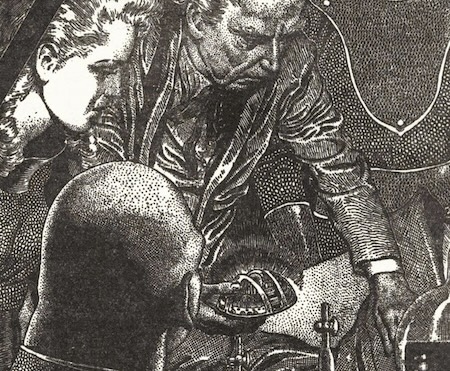
Update 20-Jun-2026: Given the shape and position of the installed NeuraLink, the implanted transceiver link from Blood on the Sun (1942) by Hal K. Wells might be a better example:
Its central portion was a silver metal disc, about five inches across and half an inch thick. From its outer rim a number of tapering tentacular appendages snaked out for lengths varying from a few inches to over a foot.The disc itself was a hollow case, with its surface curved as though to fit just inside the top of a human skull. Ramsey had cut away the top of the case, revealing an interior filled with a maze of tiny coils and other mechanism of almost microscopic fineness. In the center of the coils was a little blue globe the size of a small marble...
“There,” he said, “is a sending and receiving set that is the most marvelously conceived piece of apparatus I have ever seen!”
“You got all of that out of that bird’s skull!” Barnes exclaimed...
Ramsey pointed to the tentacle-like extensions from the central disc. They were as thick as a man’s finger where they left the disc, then tapered and branched into filaments of hairlike fineness.
('the most marvelously conceived piece of apparatus I have ever seen')THOSE wires,” Ramsey said, “were connected with every vital part of the carrier’s brain. Some of them ran to the optic and auditory nerves, picking up sight and sound which the mechanism in the disc transmitted to the distant operator. Others were connected with the areas of voluntary muscular movement. They received impulses from the operator and moved corresponding parts of the carrier’s body in response.”
End update.
An earlier version of the basic idea is the communications implant from the 1981 novel Oath of Fealty, by Jerry Pournelle and Larry Niven.
Scroll down for more stories in the same category. (Story submitted 8/13/2020)
Follow this kind of news @Technovelgy.| Email | RSS | Blog It | Stumble | del.icio.us | Digg | Reddit |
Would
you like to contribute a story tip?
It's easy:
Get the URL of the story, and the related sf author, and add
it here.
Comment/Join discussion ( 0 )
Related News Stories - (" Computer ")
ElectionSim: China's 'Ender's Game' Battle Sim, Or Lem's 'Kingdom In A Box'?
'So, Ender, we will now begin your education.' - Orson Scott Card, 1985.
Muxcard Redditor's DIY Credit Card-Sized Computer
It's a computer, but just barely.
Cortex 1 - Today A Warehouse, Tomorrow A Calculator Planet
'There were cubic miles of it, and it glistened like a silvery Christmas tree...' - Clifford Simak, 1949.
Is Agentic AI The Wrong Kind Of Smartness?
'It’s smart enough to go wrong in very complicated ways, but not smart enough to help us find out what’s wrong.' - Isaac Asimov, 1975.
Technovelgy (that's tech-novel-gee!) is devoted to the creative science inventions and ideas of sf authors. Look for the Invention Category that interests you, the Glossary, the Invention Timeline, or see what's New.

Science Fiction
Timeline
1600-1899
1900-1939
1940's 1950's
1960's 1970's
1980's 1990's
2000's 2010's
Current News
'If Anyone Is Watching Earth...'
'Our study of your race has convinced us that you are not fitted to leave your planet in the present state of your civilization.'
Epirus High-Power Microwave Defeats Drones
'...the spreading beam of the deranging ray struck them, and Then one toppled and fell. Then another.'
Cloud Of Space Rubbish From China's Long March Rocket
'Within seconds the material was spread out over fifty yards, in a matter of hours it might occupy several cubic miles of space...'
Biomimetic Tendons From Rochu Robotics
'... the curious parallelism to animal motions.'
Living Human Neuron Biological Compute Rack
'The men are dead, but their acquired wisdom lives on and I am the beneficiary.'
Martha Stewart Approves Ojai 'Living Room On Wheels'
'Young people found the driverless car admirable for petting.'
ESA's Draco To Study Heat Of Reentry
'...a synthetic which air-friction would erode.'
Buy A Galaxy? Maybe Start Smaller
'The sky is the limit' just got higher.
The United States Space Academy Is Official
'Is our orbit to Space Academy clear?'
Is There A Global Problem With Who Is Having Children?
'After twenty generations of shillyshallying...'
You Will Eat The Cookies Made From Plastic...
'Our planes are going to start bringing in bales of discarded plastics...'
It's A Giant Robot! You Reporters Have Been Warned!
'... completely forgetting the ship at sight of the awesome figure and great head of the giant Gaut...'
Birds Learn To Sing Pictures ala Frank Herbert's Distrans
'We will fight in the time of fighting.'
ElectionSim: China's 'Ender's Game' Battle Sim, Or Lem's 'Kingdom In A Box'?
'So, Ender, we will now begin your education.'
Tactile Skin Supplier Map
'What strange sensitivity! What an amazing development of science was manifested in every move and act and word of this Robot!'
Flock Stymied By 'Adversarial Fashion'
'Forget the head atop it, the legs below, feet, arms, hands. It compels erasure.'

