
Science Fiction
Dictionary
A B C D E F G H I J K L M N O P Q R S T U V W X Y Z

 |
Is A Hollow Rotating Asteroid Habitat Practical?

How can we best house and support the hardy miners of asteroids? A new paper suggests that hollowing out a suitable asteroid, and then spinning it for artificial gravity, would solve a lot of problems.
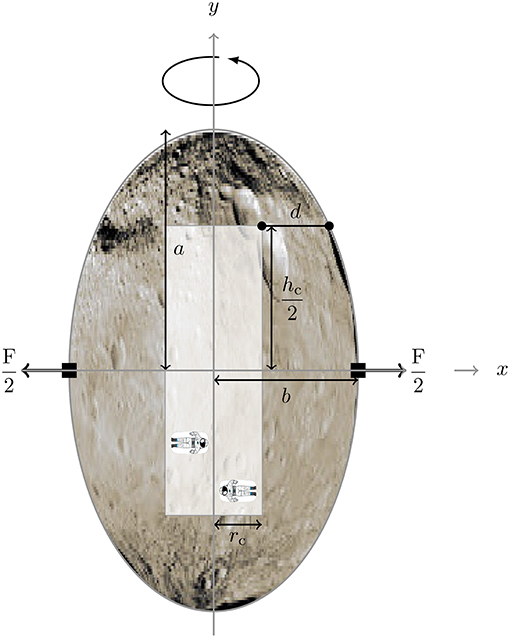
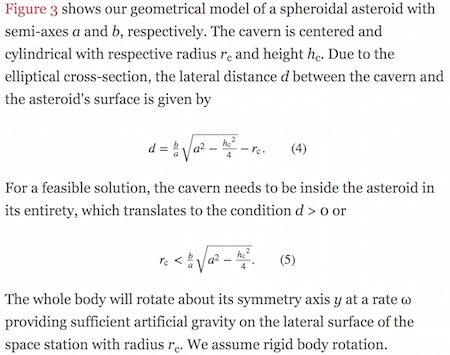
(Spinning a hollow spheroidal asteroid)
Here, we assume the entire mined asteroid to rotate at a sufficient rate for artificial gravity and investigate its use for housing a habitat inside. In this study we present how to estimate the necessary spin rate assuming a cylindrical space station inside a mined asteroid and discuss the implications arising from substantial material stress given the required rotation rate. We estimate the required material strength using two relatively simple analytical models and discuss applicability to rocky near-Earth asteroids.A study on how much gravity is needed to keep the human body upright was performed by Harris et al. (2014). They found that the threshold level of gravity needed to influence a persons orientation judgment is about 15 % of the gravity on Earth's surface, which is approximately the gravity acting on the Lunar surface. Martian gravity, 38 % of Earth's gravity, should be enough for astronauts to orient themselves and maintain balance.
As a consequence of a lack of experiments on the influence of reduced gravity on the human body we adopt the value of 38 % of Earth's gravity (gE) as starting point for our theoretical approach. We assume that a rotation of the asteroid has to cause an artificial gravity of minimum 0.38 gE in order to sustain long term healthy conditions for humans on the station.
An important aspect which directly affects applicability of this approach is sufficient material strength to sustain the required rotation rates. Although little is known about the exact composition of asteroids in the relevant size domain (≲ 0.5 km), observational data on fast rotators indicate individual objects with notable material strength. 2000 DO8, the fastest rotator in the IAU Minor Planet Center's list1 has a rotation period of 1.3 min. Assuming a long axis of about 80 m for this object, (Pravec et al., 2002) find a minimum tensile strength of approx. 2 × 10⁴ Pa, three orders of magnitude less than the typical tensile strength of solid rock...
(From Stability of a Rotating Asteroid Housing a Space Station
Thomas I. Maindl, Roman Miksch and Birgit Loibnegger)
Science fiction writers have been thinking about the idea that asteroids can be used as space stations or habitats for a long time. For example, Robert Heinlein wrote about moving an asteroid to a suitable orbit and then creating a tented surface habitat in his 1939 story Misfit.
Raymond Z. Gallun proposed homesteading on a large planetoid in his 1951 story Asteroid of Fear.
The earliest use of the phrase hollow asteroid is in an amusing 1944 short story Juke Box Asteroid, by Joseph Farrell.
However, the earliest story I know about is also the closest to the proposal in this paper. In his 1932 story Electronic Siege, John Campbell described a clever rotating hollow planetoid habitat that actually addresses some of the concerns described in this paper.
It was nearly twenty-four hours later that they finally approached their destination, a tiny, five-mile world of solid metal, a part of the nickel-steel core of some long vanished planet. Its surface turned swiftly beneath them, flashing around in moments as they watched, a surface made up of great crags and clefts of metal, broken, barren masses of metal.
“Lord — it would be impossible to establish a city on the surface of that top!” exclaimed one of the Patrolmen. “The centrifugal spin there would throw anything off into space.”
“How about the inside of it then?” asked one of the guards, smiling at him...
"...When the colony was established, the whole interior was carved out with atomic burners — burned the stuff out into gas, and let it escape. The shell’s about half a mile thick. Inside, the centrifugal force gives an acceleration just equal to one earth gravity, we’re up to speed, and you can see we have about an earth-weight away from it now. And an artificial sun gives plenty of light.”
Scroll down for more stories in the same category. (Story submitted 6/27/2021)
Follow this kind of news @Technovelgy.| Email | RSS | Blog It | Stumble | del.icio.us | Digg | Reddit |
Would
you like to contribute a story tip?
It's easy:
Get the URL of the story, and the related sf author, and add
it here.
Comment/Join discussion ( 0 )
Related News Stories - (" Space Tech ")
'If Anyone Is Watching Earth...'
'Our study of your race has convinced us that you are not fitted to leave your planet in the present state of your civilization.' - Arthur C. Clarke, 1946.
Cloud Of Space Rubbish From China's Long March Rocket
'Within seconds the material was spread out over fifty yards, in a matter of hours it might occupy several cubic miles of space...'
ESA's Draco To Study Heat Of Reentry
'...a synthetic which air-friction would erode.' - EE Doc Smith, 1934.
The United States Space Academy Is Official
'Is our orbit to Space Academy clear?' - Carey Rockwell
Technovelgy (that's tech-novel-gee!) is devoted to the creative science inventions and ideas of sf authors. Look for the Invention Category that interests you, the Glossary, the Invention Timeline, or see what's New.

Science Fiction
Timeline
1600-1899
1900-1939
1940's 1950's
1960's 1970's
1980's 1990's
2000's 2010's
Current News
'If Anyone Is Watching Earth...'
'Our study of your race has convinced us that you are not fitted to leave your planet in the present state of your civilization.'
Epirus High-Power Microwave Defeats Drones
'...the spreading beam of the deranging ray struck them, and Then one toppled and fell. Then another.'
Cloud Of Space Rubbish From China's Long March Rocket
'Within seconds the material was spread out over fifty yards, in a matter of hours it might occupy several cubic miles of space...'
Biomimetic Tendons From Rochu Robotics
'... the curious parallelism to animal motions.'
Living Human Neuron Biological Compute Rack
'The men are dead, but their acquired wisdom lives on and I am the beneficiary.'
Martha Stewart Approves Ojai 'Living Room On Wheels'
'Young people found the driverless car admirable for petting.'
ESA's Draco To Study Heat Of Reentry
'...a synthetic which air-friction would erode.'
Buy A Galaxy? Maybe Start Smaller
'The sky is the limit' just got higher.
The United States Space Academy Is Official
'Is our orbit to Space Academy clear?'
Is There A Global Problem With Who Is Having Children?
'After twenty generations of shillyshallying...'
You Will Eat The Cookies Made From Plastic...
'Our planes are going to start bringing in bales of discarded plastics...'
It's A Giant Robot! You Reporters Have Been Warned!
'... completely forgetting the ship at sight of the awesome figure and great head of the giant Gaut...'
Birds Learn To Sing Pictures ala Frank Herbert's Distrans
'We will fight in the time of fighting.'
ElectionSim: China's 'Ender's Game' Battle Sim, Or Lem's 'Kingdom In A Box'?
'So, Ender, we will now begin your education.'
Tactile Skin Supplier Map
'What strange sensitivity! What an amazing development of science was manifested in every move and act and word of this Robot!'
Flock Stymied By 'Adversarial Fashion'
'Forget the head atop it, the legs below, feet, arms, hands. It compels erasure.'

