
Science Fiction
Dictionary
A B C D E F G H I J K L M N O P Q R S T U V W X Y Z

 |
Chrysalis Generation Ship to Alpha Centauri

Do you like long voyages? Well, science fiction writers created the idea of the generation ship to describe a spacecraft able to travel in real space from star to star. And yes, it would take centuries - many generations.

(Chrysalis Generation Ship to Alpha Centauri)
Project Hyperion was established to encourage engineers to create plans for generation ships that met these conditions:
- Habitability for 1,000 ± 500 people over centuries
- Artificial gravity via rotation
- A society that ensures good living conditions, including essential provisions such as shelter, clothing, and other basic needs.
- Robust life support systems for food, water, waste, and the atmosphere
- Knowledge transfer mechanisms to retain culture and technologies
The craft, called Chrysalis, could make the 25 trillion mile (40 trillion kilometer) journey in around 400 years, the engineers say in their project brief, meaning many of its potential passengers would only know life on the craft.Chrysalis is designed to house several generations of people until it enters the star system, where it could shuttle them to the surface of the planet Proxima Centuri b — an Earth-size exoplanet that is thought to be potentially habitable...
he vessel, which would measure 36 miles (58 km) in length, would be constructed like a Russian nesting doll, with several layers encompassing each other around a central core. The layers include communal spaces, farms, gardens, homes, warehouses and other shared facilities, each powered by nuclear fusion reactors.
(Via LiveScience.)
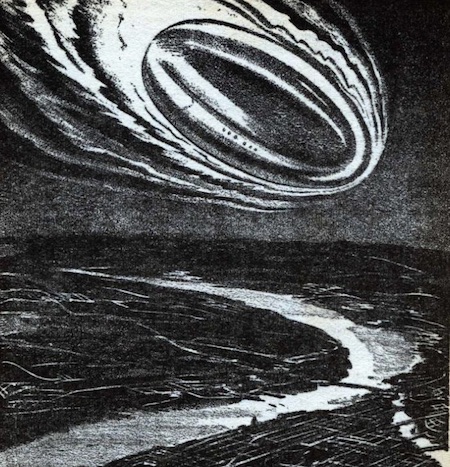
Science fiction writers and artists have also worked on the idea of Multi-Generation Space Vessels; consider this example from The Return of the Murians (1936) by Nat Schachner:
This was their world, their planet — this swift-traveling, yet seemingly moveless vessel. They knew no other, knew nothing of the wilder, freer life, except for tales distorted by the mists of time and many tellings, legends that smacked, perchance, of wish fulfillments for that earlier Golden Age of their ancestors.Warlo, his tawny beard and high forehead granting him a nobility his slighter frame could not, turned wearily back to his instruments. On him devolved the management of the space ship, the government of its thousand-odd inhabitants.
Their strangely remote ancestors had builded well. The long ellipsoid of still unrusted, still unpitted metal was almost a mile from stem to stern, and half a mile in diameter at its widest point. It was a world in miniature, a closed cycle in which nothing was wasted, nothing dissipated.
The radiant walls still glowed as of old, though somewhat dimmer, and furnished light and the stimulating rays without which life cannot exist. One half of the ship — toward the stern — held earth and loam — in which strange plants — succulent, nourishing — grew and flourished. Stranger animals, small but fat and tender, grew to maturity in crystal-inclosed runs, bred their young, and paid the eventual penalty for all toothsome, subordinate forms of life.
By careful, exact measuring a delicate balance was established between plant and animal, between carbon dioxide and oxygen, between warmth and cold. A delicate balance, that called for unceasing, unremitting attention on the part of the leader and his corps of scientists ; a balance, that, once broken, would lead to irremediable disaster.
(The landing 'The Return of the Murians' by Nat Schachner)
Robert H. Goddard was perhaps the first to write about multi-generational interstellar voyages in his 1918 essay "The Last Migration". He described the death of the Sun and the need for an interstellar ark. The crew would face the centuries of travel by sleeping and would be awakened when they reach another star system.
Take a look at the article for the first use of the sf phrase "generation ship" from Star Ship (1955), by E.C. Tubb, which has additional references.
Scroll down for more stories in the same category. (Story submitted 8/19/2025)
Follow this kind of news @Technovelgy.| Email | RSS | Blog It | Stumble | del.icio.us | Digg | Reddit |
Would
you like to contribute a story tip?
It's easy:
Get the URL of the story, and the related sf author, and add
it here.
Comment/Join discussion ( 0 )
Related News Stories - (" Space Tech ")
'If Anyone Is Watching Earth...'
'Our study of your race has convinced us that you are not fitted to leave your planet in the present state of your civilization.' - Arthur C. Clarke, 1946.
Cloud Of Space Rubbish From China's Long March Rocket
'Within seconds the material was spread out over fifty yards, in a matter of hours it might occupy several cubic miles of space...'
ESA's Draco To Study Heat Of Reentry
'...a synthetic which air-friction would erode.' - EE Doc Smith, 1934.
The United States Space Academy Is Official
'Is our orbit to Space Academy clear?' - Carey Rockwell
Technovelgy (that's tech-novel-gee!) is devoted to the creative science inventions and ideas of sf authors. Look for the Invention Category that interests you, the Glossary, the Invention Timeline, or see what's New.

Science Fiction
Timeline
1600-1899
1900-1939
1940's 1950's
1960's 1970's
1980's 1990's
2000's 2010's
Current News
'If Anyone Is Watching Earth...'
'Our study of your race has convinced us that you are not fitted to leave your planet in the present state of your civilization.'
Epirus High-Power Microwave Defeats Drones
'...the spreading beam of the deranging ray struck them, and Then one toppled and fell. Then another.'
Cloud Of Space Rubbish From China's Long March Rocket
'Within seconds the material was spread out over fifty yards, in a matter of hours it might occupy several cubic miles of space...'
Biomimetic Tendons From Rochu Robotics
'... the curious parallelism to animal motions.'
Living Human Neuron Biological Compute Rack
'The men are dead, but their acquired wisdom lives on and I am the beneficiary.'
Martha Stewart Approves Ojai 'Living Room On Wheels'
'Young people found the driverless car admirable for petting.'
ESA's Draco To Study Heat Of Reentry
'...a synthetic which air-friction would erode.'
Buy A Galaxy? Maybe Start Smaller
'The sky is the limit' just got higher.
The United States Space Academy Is Official
'Is our orbit to Space Academy clear?'
Is There A Global Problem With Who Is Having Children?
'After twenty generations of shillyshallying...'
You Will Eat The Cookies Made From Plastic...
'Our planes are going to start bringing in bales of discarded plastics...'
It's A Giant Robot! You Reporters Have Been Warned!
'... completely forgetting the ship at sight of the awesome figure and great head of the giant Gaut...'
Birds Learn To Sing Pictures ala Frank Herbert's Distrans
'We will fight in the time of fighting.'
ElectionSim: China's 'Ender's Game' Battle Sim, Or Lem's 'Kingdom In A Box'?
'So, Ender, we will now begin your education.'
Tactile Skin Supplier Map
'What strange sensitivity! What an amazing development of science was manifested in every move and act and word of this Robot!'
Flock Stymied By 'Adversarial Fashion'
'Forget the head atop it, the legs below, feet, arms, hands. It compels erasure.'

