
Science Fiction
Dictionary
A B C D E F G H I J K L M N O P Q R S T U V W X Y Z
Latest By
Category:
Armor
Artificial
Intelligence
Biology
Clothing
Communication
Computers
Culture
Data Storage
Displays
Engineering
Entertainment
Food
Input Devices
Lifestyle
Living Space
Manufacturing
Material
Media
Medical
Miscellaneous
Robotics
Security
Space Tech
Spacecraft
Surveillance
Transportation
Travel
Vehicle
Virtual
Person
Warfare
Weapon
Work
"Science fiction writers foresee the inevitable, and although problems and catastrophes may be inevitable, solutions are not."
- Isaac Asimov

 |
| Waldo | ||
| A telefactoring device; also known as the Waldo F. Jones Synchronous Reduplicating Pantograph. |

This story has been largely forgotten (even though it still makes great reading). The notion of a waldo, however, has not. The word itself has come into common usage; the American Heritage Dictionary describes it as follows: "A mechanical agent, such as a gripper arm, controlled by a human limb." Real-life waldoes were developed for the nuclear industry during WWII; they were named after the invention described by Heinlein.
This technology is known today by the more generic term "telefactoring"; it is used in a variety of industries.
In the story, Waldo is in orbit around the Earth, in his space station called "Wheelchair"; he controls waldoes far below, on Earth.
| Near the man, mounted on the usual stand, were a pair of primary waldoes, elbow-length and human digited. They were floating on the line, in parallel with a similar pair physically in front of Waldo. The secondary waldoes, whose actions could be controlled by Waldo himself by means of his primaries, were mounted in front of the power tool in the position of the operator.
‘Very well, friend Alec - the gloves.’ Jenkins thrust his arms into the waldoes and waited. Waldo put his arms into the primary pair before him; all three pairs, including the secondary pair mounted before the machine, came to life. Jenkins bit his lip, as if he found unpleasant the sensation of having his fingers manipulated by the gauntlets he wore.
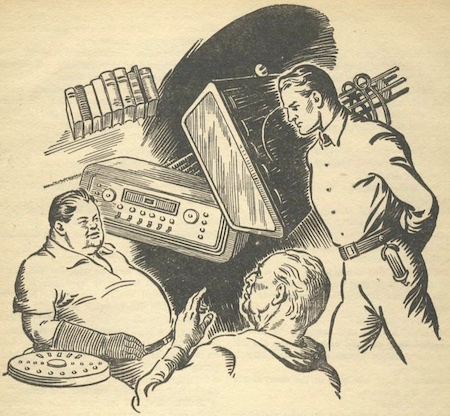 (Waldoes worn by Waldo from 'Waldo' by Robert Heinlein) Waldo flexed and extended his fingers gently; the two pairs of waldoes in the screen followed in exact, simultaneous parallelism. “Feel it, my dear Alec,” Waldo advised. "Gently, gently—the sensitive touch. Make your muscles work for you." He then started hand movements of definite pattern; the waldoes at the power tool reached up, switched on the power, and began gently, gracefully, to continue the machining of the casting. A mechanical hand reached down, adjusted a vernier, while the other increased the flow of oil cooling the cutting edge. “Rhythm. Alec, rhythm. No jerkiness, no unnecessary movement. Try to get in time with me." |
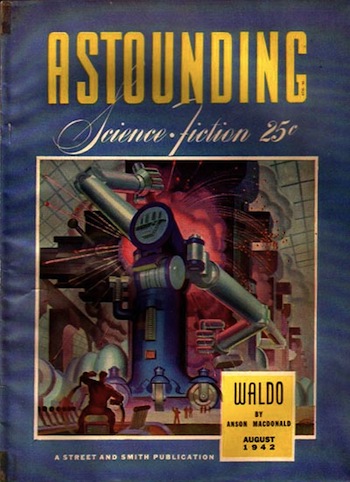
| Technovelgy from Waldo,
by Robert Heinlein. Published by Astounding Science Fiction in 1942 Additional resources -
|
Heinlein shows his creativity by giving his character a problem (myasthenia gravis - degenerative muscle weakness) and then literally giving him the tool to solve it. You'll also enjoy his laboratory (in orbit, of course, to give Waldo maximum mobility).
A pantograph is a device with a simple physical connection between a pointer and a drawing pen on a piece of paper. Altering the linkage between the pointer and the pen alters the scale of the drawing. The pantograph dates from 1630. Thomas Jefferson liked them; he built one into Monticello.
In Oath of Fealty, by Larry Niven and Jerry Pournelle, telefactor operators who all live in the same arcology assist in a variety of tasks around the globe (and on the moon). At one point, they go on strike; a case of acting locally and globally.
the mechanical hand from Buck Rogers, 2430 AD (1929) by Philip Nowlan (w/D. Calkins), microhands from Microhands (Микроруки) (1931) by Boris Zhitkov, iron fingers from The Death's Head Meteor (1931) by Neil R. Jones, robot hands from The Iron World (1937) by Otis Adelbert Kline, robot surgeon-hand from War Veteran (1955) by Philip K. Dick, robotic hand from The Door Into Summer (1956) by Robert Heinlein, interchangeable hands from The Three Stigmata of Palmer Eldritch (1965) by Philip K. Dick, surgical hand from Clans of the Alphane Moon (1964) by Philip K. Dick and office hand from The Human Blend (2010) by Alan Dean Foster.
Comment/Join this discussion ( 5 ) | RSS/XML | Blog This |
Additional
resources:
More Ideas
and Technology from Waldo
More Ideas
and Technology by Robert Heinlein
Tech news articles related to Waldo
Tech news articles related to works by Robert Heinlein
Waldo-related
news articles:
- Tmsuk T52 Enryu Support Dragon Hyper Rescue Robot
- Robonaut Performs Hubble Space Telescope Repair Tasks
- Robonaut Centaur At NextFest 2006
- Heinlein's Giant Waldo Comes To Life
- Mediseus Surgical Drilling Simuator Remote Haptic Tutor
- Be Master To Robot Slave
- RAPUD Robotic Arm Helps Disabled Reach
- Giant Robotic Hand Video
- WIND Wearable Robot Controller
- PossessedHand Borgs Your Hands To Teach You
- Raytheon Sarcos Exoskeletonized Ditch Witch
- Festo ExoHand Fine Motor Skill Robotic Hand
- Calligraphy Robot Preserves An Ancient Skill
- CAPIO Exoskeleton Controls AILA Robot
- Smart Glove Controls 3D Printed Robotic Arm (Waldo!)
- Jeff Bezos Tries Waldoes (Robotic Hands)
- Ingenious Engineer Creates DIY Feeding Robot
- NAVER Labs Haptic Device 2.0 Robot vs. IKEA
- GITAI R1 Lunar Rover Like NASA Robonaut Centaur
- Giant Robotic Hands At Gundam Next Future Science
- Sunday Robotics 'Memo' Bot Has Unique Training Glove
- World's Largest Teleoperated Arm
| Biomimetic Tendons From Rochu Robotics |
| You Will Eat The Cookies Made From Plastic... |
| ICE Buys Shock Gloves Like Batman's |
| When Colds Threaten You Can't Do This - Or Can You? |
Want to Contribute an
Item?
It's easy:
Get the name of the item, a
quote, the book's name and the author's name, and Add
it here.
| <Previous | Next> |
|
|
|
Technovelgy (that's tech-novel-gee!) is devoted to the creative science inventions and ideas of sf authors. Look for the Invention Category that interests you, the Glossary, the Science Fiction Invention Timeline, or see what's New.
|

Science Fiction
Timeline
1600-1899
1900-1939
1940's 1950's
1960's 1970's
1980's 1990's
2000's 2010's
'Our study of your race has convinced us that you are not fitted to leave your planet in the present state of your civilization.'
'...the spreading beam of the deranging ray struck them, and Then one toppled and fell. Then another.'
'Within seconds the material was spread out over fifty yards, in a matter of hours it might occupy several cubic miles of space...'
'The men are dead, but their acquired wisdom lives on and I am the beneficiary.'
'Young people found the driverless car admirable for petting.'
'After twenty generations of shillyshallying...'

