
Science Fiction
Dictionary
A B C D E F G H I J K L M N O P Q R S T U V W X Y Z
Latest By
Category:
Armor
Artificial
Intelligence
Biology
Clothing
Communication
Computers
Culture
Data Storage
Displays
Engineering
Entertainment
Food
Input Devices
Lifestyle
Living Space
Manufacturing
Material
Media
Medical
Miscellaneous
Robotics
Security
Space Tech
Spacecraft
Surveillance
Transportation
Travel
Vehicle
Virtual
Person
Warfare
Weapon
Work
"did I had an extremely expensive wife - she would see a new car that she liked and just buy it... under California law I was bound to buy her debts. I think I turned out 16 novels in five years."
- Philip K. Dick

 |
| Robotic Horse - Faithful Cybernetic Companion | ||
| A robot that is specifically designed to closely resemble a horse. |

FESS (the name of the horse mentioned in the following quote) had one charming idiosyncrasy; a faulty capacitor would blow just at the most exciting (dangerous) moments.
| Rod cradled the robot "brain" in the crook of one arm, leaving one arm free to negotiate the air lock. Outside again, he pressed a stud in the side of the ship. A large door lifted from the side of the pseudo-asteroid. Inside, a great black horse hung from shock webbing, head between its forelegs, eyes closed.
Rod pressed a button; a crane extended from the cargo space. The horse swung out on the crane, was lowered till its hooves touched the ground. Rod twisted the saddlehorn, and a panel in the horse's side slid open. Rod placed the brain inside the panel, tightened the clamp and the connections, then twisted the saddlehorn back; the panel slid shut. Slowly the horse raised its head, wiggled its ears, blinked twice, gave a tentative whinny. "All as it should be," said the voice behind Rod's ear. The horse champed at the bit. "If you'll let me out of this cat's cradle, I'll check the motor circuits." Rod grinned and freed the webbing. The horse reared up, pawing the air, then sprang into a gallop. Rod watched the robot run, taking a good look at his surroundings in the process. The asteroid-ship had landed in the center of a meadow, shaggy with summer grass, ringed by oak, hickory, maple, and ash. It was night, but the meadow was flooded with the light of three moons. The robot cantered back toward Rod, reared to a halt before him. Forehooves thudded on the ground; the great indigo eyes turned to look at Rod, the ears pricked forward.
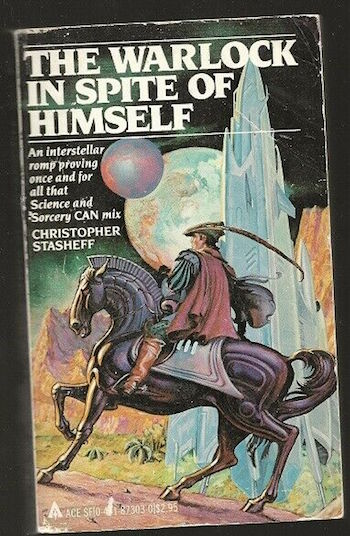 ('The Warlock in Spite of Himself' by Christopher Stasheff)
"I'm fit," Fess reported.
|
| Technovelgy from The Warlock in Spite of Himself,
by Christopher Stasheff. Published by Bantam Books in 1969 Additional resources -
|
FESS gets his name from an acronym:
Fess (a name derived from trying to pronounce "FCC" as a single word) had survived, thanks to his epilepsy. He had a weak capacitor that, when over-strained, released all its stored energy in a massive surge lasting several milli-seconds. When the preliminary symptoms of this electronic seizure—mainly a fuzziness in Fess's calculations—appeared, a master circuit breaker popped, and the faulty capacitor discharged in isolation from the rest of Fess's circuits; but the robot was out of commission until the circuit breaker was reset.
Since the seizures occurred during moments of great stress—such as trying to land a spaceship-cum-asteroid while analyzing an aberrant radio wave, or trying to protect a master from three simultaneous murderers— Fess had survived the Interregnum; for, when the Proletarians had attacked his masters, he had fought manfully for about twenty-five seconds, then collapsed. He had thus become a rarity—the courageous servant who had survived. He was one of five FCC robots still functioning.
Another variation on the robotic horse idea is the horse named Black in Roger Zelazny's stories about Dilvish the Damned. Black is a metallic horse; that is, he is a demon who manifests as a horse made of metal (as opposed to being a robotic horse - hey, it's a fantasy, you can do what you want).
Compare to the steam horse from Le Monde Tel Qu'il Sera (The World As It Shall Be) (1846) by Emile Souvestre,
the steam cart horse from Frank Reade and his Steam Horse (1883) by Harry Enton,
the robass from The Quest for Saint Aquin (1951) by Anthony Boucher and
the chevaline from The Diamond Age (1995) by Neal Stephenson.
Considering it as transport with legs, compare to the centipede-machine from Monsters of Mars (1931) by Edmond Hamilton, the transport walkers from A Little Further Up the Fox (1989) by George M. Ewing, the centipede from Killing Titan (2015) by Greg Bear and the walking fort from The Killing Machine (1964) by Jack Vance.
Fess was very dutiful. He was also an antique, one of the few remaining FCC (Faithful Cybernetic Companion) robots, early models now two thousand years out of date. The FCC robots had been programmed for extreme loyalty and, as a consequence, had perished in droves while defending their masters during the bloody Interregnum between the collapse of the ancient Galactic Union and the rise of the Proletarian Eclectic State of Terra.
Comment/Join this discussion ( 19 ) | RSS/XML | Blog This |
Additional
resources:
More Ideas
and Technology from The Warlock in Spite of Himself
More Ideas
and Technology by Christopher Stasheff
Tech news articles related to The Warlock in Spite of Himself
Tech news articles related to works by Christopher Stasheff
Robotic Horse - Faithful Cybernetic Companion-related
news articles:
- Loomo Mini Transporter Robot Companion You Ride On
- Pengxing Intelligent Robot Horse You Can Ride
- Mechanical Horse Sculpture Gallops In Place
| Nifty Folding Electric Bicycles! |
| Boring Company Drills Asimov's Single Vehicle Tunnels |
| Boring Company Vegas Loop Like Asimov Said |
| SpaceX Rocket Shuttle Point-To-Point On Earth |
Want to Contribute an
Item?
It's easy:
Get the name of the item, a
quote, the book's name and the author's name, and Add
it here.
| <Previous | Next> |
|
|
|
Technovelgy (that's tech-novel-gee!) is devoted to the creative science inventions and ideas of sf authors. Look for the Invention Category that interests you, the Glossary, the Science Fiction Invention Timeline, or see what's New.
|

Science Fiction
Timeline
1600-1899
1900-1939
1940's 1950's
1960's 1970's
1980's 1990's
2000's 2010's
'Our study of your race has convinced us that you are not fitted to leave your planet in the present state of your civilization.'
'...the spreading beam of the deranging ray struck them, and Then one toppled and fell. Then another.'
'Within seconds the material was spread out over fifty yards, in a matter of hours it might occupy several cubic miles of space...'
'The men are dead, but their acquired wisdom lives on and I am the beneficiary.'
'Young people found the driverless car admirable for petting.'
'After twenty generations of shillyshallying...'

