
Science Fiction
Dictionary
A B C D E F G H I J K L M N O P Q R S T U V W X Y Z
Latest By
Category:
Armor
Artificial
Intelligence
Biology
Clothing
Communication
Computers
Culture
Data Storage
Displays
Engineering
Entertainment
Food
Input Devices
Lifestyle
Living Space
Manufacturing
Material
Media
Medical
Miscellaneous
Robotics
Security
Space Tech
Spacecraft
Surveillance
Transportation
Travel
Vehicle
Virtual
Person
Warfare
Weapon
Work
"...the space defense initiative drove the USSR bankrupt, and it originated at my house in Tarzana."
- Larry Niven

 |
| Hyperspace Beacon | ||
| Located in real space, these devices provide reference points in hyperspace to make navigation possible. |

How can you find your way through hyperspace, that featureless void outside of real space? You need beacons to show the way.
| The first ships to enter hyperspace had no place to go - and no way to tell if they had even moved. The beacons solved that problem and opened up the entire universe. They are built on planets and generate tremendous amounts of power. This power is turned into radiation that is punched through into hyperspace. Every beacon has a code signal as part of its radiation and represents a measurable point in hyperspace. Triangulation and quadrature works for navigation - only it follows its own rules.
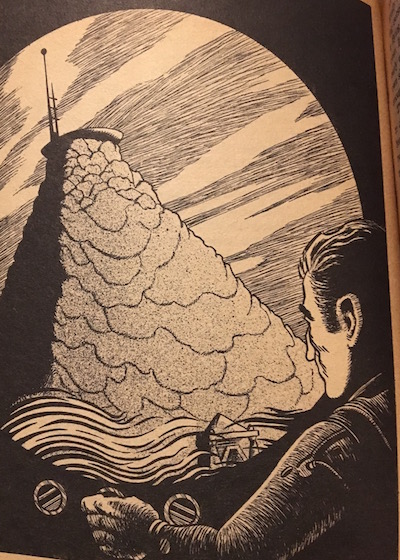
For a hyperspace jump, you need at least four beacons for an accurate fix. For long jumps, navigators use up to seven or eight. So every beacon is important and every one has to keep operating. That is where I and the other troubleshooters come in. |
| Technovelgy from The Repairman,
by Harry Harrison. Published by Galaxy Science Fiction in 1959 Additional resources -
|
What happens when one of them breaks down? You can't get to it directly through hyperspace; you can get close and then travel for months through real space.
The old ones break down more often. Like the Mark III -
This is an early description of the hyperspace beacon concept. The same idea and term were used in the television show Babylon 5; without beacons, ships would drift endlessly through featureless hyperspace, unable to discern their location relative to real space.
You'll find an earlier example in Troubled Star, a 1952 novel by George O. Smith: see space beacon. You'll find another version (not quite the same idea) in The Cosmic Blinker (1953) by Eando Binder; see Artificially Pulsating Star.
Compare to the Photoelectric Telescope (Photoelectric Eyes) from The Cometeers (1936) by Jack Williamson, the
Liquid Mirror Telescope from Old Faithful (1934) by Raymond Z. Gallun, the
electro-telescope from Blood of the Moon (1936) by Ray Cummings, the
ultra-telescope ray from The Moon Weed (1931) by Harl Vincent, and the robot observatory from Space Rating (1939) by John Berryman.
I looked at the blueprints he gave me and felt my eyes glaze with horror. "It's a monstrosity! It looks more like a distillery than a beacon - must be a few hundred meters high...
Comment/Join this discussion ( 0 ) | RSS/XML | Blog This |
Additional
resources:
More Ideas
and Technology from The Repairman
More Ideas
and Technology by Harry Harrison
Tech news articles related to The Repairman
Tech news articles related to works by Harry Harrison
Hyperspace Beacon-related
news articles:
- Is 'The Pulsar Positioning System' Evidence For SETI?
- NASA SEXTANT First With X-Ray Nav In Space
- Fast Radio Bursts And Space Beacons For Interstellar Navigation
| 'If Anyone Is Watching Earth...' |
| Cloud Of Space Rubbish From China's Long March Rocket |
| ESA's Draco To Study Heat Of Reentry |
| The United States Space Academy Is Official |
Want to Contribute an
Item?
It's easy:
Get the name of the item, a
quote, the book's name and the author's name, and Add
it here.
| <Previous | Next> |
|
|
|
Technovelgy (that's tech-novel-gee!) is devoted to the creative science inventions and ideas of sf authors. Look for the Invention Category that interests you, the Glossary, the Science Fiction Invention Timeline, or see what's New.
|

Science Fiction
Timeline
1600-1899
1900-1939
1940's 1950's
1960's 1970's
1980's 1990's
2000's 2010's
'Our study of your race has convinced us that you are not fitted to leave your planet in the present state of your civilization.'
'...the spreading beam of the deranging ray struck them, and Then one toppled and fell. Then another.'
'Within seconds the material was spread out over fifty yards, in a matter of hours it might occupy several cubic miles of space...'
'The men are dead, but their acquired wisdom lives on and I am the beneficiary.'
'Young people found the driverless car admirable for petting.'
'After twenty generations of shillyshallying...'

