
Science Fiction
Dictionary
A B C D E F G H I J K L M N O P Q R S T U V W X Y Z

 |
Robots Taught Human Communication Secrets

Roboticists are letting robots learn all of the secret ways that human beings share information with each other. In a recent paper, researchers at Carnegie Mellon, ATR Robotics in Kyoto and Osaka University programmed two different robots to use seemingly unintentional gestures to communicate information to human beings.
The researchers used the well-known robots Robovie (which has a stylized human-like visage) and the Geminoid robot (which has an eerily human face). The introductory abstract for their paper gives you the basic idea:
Now watch the following video, and see how well robots do in interpreting human gestures and how well the humans do in interpreting robot gestures.
"Human communication involves a number of nonverbal cues that are seemingly unintentional, unconscious, and automatic—both in their production and perception—and convey rich information on the emotional state and intentions of an individual. One family of such cues is called “nonverbal leakage.” In this paper, we explore whether people can read nonverbal leakage cues—particularly gaze cues—in humanlike robots and make inferences on robots’ intentions, and whether the physical design of the robot affects these inferences. We designed a gaze cue for Geminoid—a highly humanlike android—and Robovie—a robot with stylized, abstract humanlike features—that allowed the robots to “leak” information on what they might have in mind. In a controlled laboratory experiment, we asked participants to play a game of guessing with either of the robots and evaluated how the gaze cue affected participants’ task performance."
The researchers found that human participants did better when paired with the human-like Geminoid robot; the human subjects were also less likely to realize that they had read a cue from the Geminoid robot. This result poses an interesting challenge to roboticists, because it gives them an incentive to get closer to the "uncanny valley" discomfort that people have when confronted with a robot that is too human-like in appearance.
Robots in fiction have also learned to communicate with secretive gestures that can be non-intentional and automatic. For example, in the 2004 movie I, Robot, Sonny communicates his intentions with a subtle wink.
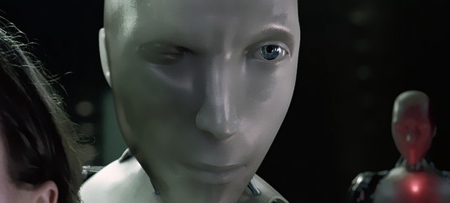
(Sonny winks to communicate in I, Robot)
From Nonverbal Leakage in Robots: Communication of Intentions through Seemingly Unintentional Behavior (pdf) via BotJunkie.
Scroll down for more stories in the same category. (Story submitted 11/4/2009)
Follow this kind of news @Technovelgy.| Email | RSS | Blog It | Stumble | del.icio.us | Digg | Reddit |
Would
you like to contribute a story tip?
It's easy:
Get the URL of the story, and the related sf author, and add
it here.
Comment/Join discussion ( 0 )
Related News Stories - (" Robotics ")
Epirus High-Power Microwave Defeats Drones
'...the spreading beam of the deranging ray struck them, and Then one toppled and fell. Then another.' - Ray Cummings, 1931.
It's A Giant Robot! You Reporters Have Been Warned!
'... completely forgetting the ship at sight of the awesome figure and great head of the giant Gaut...'
Tactile Skin Supplier Map
'What strange sensitivity! What an amazing development of science was manifested in every move and act and word of this Robot!' - Ray Cummings, 1931.
Robot Bees 3D Printed By Festo
'At first I was struck by the large size of these bees..' - Ernst Junger, 1957.
Technovelgy (that's tech-novel-gee!) is devoted to the creative science inventions and ideas of sf authors. Look for the Invention Category that interests you, the Glossary, the Invention Timeline, or see what's New.

Science Fiction
Timeline
1600-1899
1900-1939
1940's 1950's
1960's 1970's
1980's 1990's
2000's 2010's
Current News
'If Anyone Is Watching Earth...'
'Our study of your race has convinced us that you are not fitted to leave your planet in the present state of your civilization.'
Epirus High-Power Microwave Defeats Drones
'...the spreading beam of the deranging ray struck them, and Then one toppled and fell. Then another.'
Cloud Of Space Rubbish From China's Long March Rocket
'Within seconds the material was spread out over fifty yards, in a matter of hours it might occupy several cubic miles of space...'
Biomimetic Tendons From Rochu Robotics
'... the curious parallelism to animal motions.'
Living Human Neuron Biological Compute Rack
'The men are dead, but their acquired wisdom lives on and I am the beneficiary.'
Martha Stewart Approves Ojai 'Living Room On Wheels'
'Young people found the driverless car admirable for petting.'
ESA's Draco To Study Heat Of Reentry
'...a synthetic which air-friction would erode.'
Buy A Galaxy? Maybe Start Smaller
'The sky is the limit' just got higher.
The United States Space Academy Is Official
'Is our orbit to Space Academy clear?'
Is There A Global Problem With Who Is Having Children?
'After twenty generations of shillyshallying...'
You Will Eat The Cookies Made From Plastic...
'Our planes are going to start bringing in bales of discarded plastics...'
It's A Giant Robot! You Reporters Have Been Warned!
'... completely forgetting the ship at sight of the awesome figure and great head of the giant Gaut...'
Birds Learn To Sing Pictures ala Frank Herbert's Distrans
'We will fight in the time of fighting.'
ElectionSim: China's 'Ender's Game' Battle Sim, Or Lem's 'Kingdom In A Box'?
'So, Ender, we will now begin your education.'
Tactile Skin Supplier Map
'What strange sensitivity! What an amazing development of science was manifested in every move and act and word of this Robot!'
Flock Stymied By 'Adversarial Fashion'
'Forget the head atop it, the legs below, feet, arms, hands. It compels erasure.'

