
Science Fiction
Dictionary
A B C D E F G H I J K L M N O P Q R S T U V W X Y Z

 |
The Most Complex Synthetic Biology Circuit

MIT researchers have created what is being called the most complex synthetic biology circuit ever built.
Synthetic biologists design cellular circuits that can perform new functions, such as sensing environmental conditions, using genes as interchangeable parts. However, most of the circuits designed so far have been limited by the difficulty in assembling genetic components that don’t interfere with each other.
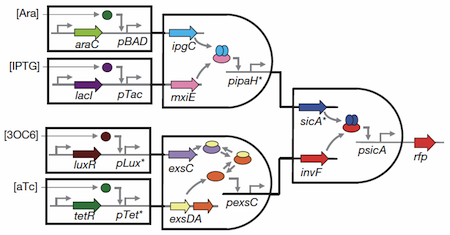
(4-input AND gate)
Unlike electronic circuits on a silicon chip, biological circuits inside a cell cannot be physically isolated from one another. “The cell is sort of a burrito. It has everything mixed together,” says Christopher Voigt, an associate professor of biological engineering at MIT.Because all the cellular machinery for reading genes and synthesizing proteins is jumbled together, researchers have to be careful that proteins that control one part of their synthetic circuit don’t hinder other parts of the circuit.
Voigt and his students have now developed circuit components that don’t interfere with one another, allowing them to produce the most complex synthetic circuit ever built. The circuit, described in the Oct. 7 issue of Nature, integrates four sensors for different molecules. Such circuits could be used in cells to precisely monitor their environments and respond appropriately.
“It’s incredibly complex, stitching together all these pieces,” says Voigt, who is co-director of the Synthetic Biology Center at MIT. Larger circuits would require computer programs that Voigt and his students are now developing, which should allow them to combine hundreds of circuits in new and useful ways.
The pathway consists of three components: an activator, a promoter and a chaperone. A promoter is a region of DNA where proteins bind to initiate transcription of a gene. An activator is one such protein. Some activators also require a chaperone protein before they can bind to DNA to initiate transcription.
Fans of science fiction writer Greg Bear recall the living "biologics" from his 1984 novel Blood Music:
Why limit oneself to silicon and protein and biochips a hundreth of a millimeter wide, when in almost every living cell there was already a functioning computer with a huge memory? A mammallian cell had a DNA complement of several million base pairs, each acting as a piece of information. What was reproduction, after all, but a compterized biological process of enormous complexity and reliability? The earliest biologic strings had been inserted into E. coli bacteria as circular plasmids...
(Read more about Greg Bear's biologics)
Via Kurzweil AI and MIT.
Scroll down for more stories in the same category. (Story submitted 10/8/2012)
Follow this kind of news @Technovelgy.| Email | RSS | Blog It | Stumble | del.icio.us | Digg | Reddit |
Would
you like to contribute a story tip?
It's easy:
Get the URL of the story, and the related sf author, and add
it here.
Comment/Join discussion ( 0 )
Related News Stories - (" Biology ")
Living Human Neuron Biological Compute Rack
'The men are dead, but their acquired wisdom lives on and I am the beneficiary.' - Dr. David H. Keller, 1931
Biological War: A Scenario
'And now they wre busily transforming all their companions, and so on, and so on...' - Greg Bear, 1984.
What'll You Have? Extinct Animals Returned, Or Synthetic Eggshells?
'...a new plastic with the characteristics of an avian eggshell.' - Michael Crichton, 1990.
Black Fungus Blocks Radiation
'You were surrounded by Astrophage most of the time' - Andy Weir, 2021.
Technovelgy (that's tech-novel-gee!) is devoted to the creative science inventions and ideas of sf authors. Look for the Invention Category that interests you, the Glossary, the Invention Timeline, or see what's New.

Science Fiction
Timeline
1600-1899
1900-1939
1940's 1950's
1960's 1970's
1980's 1990's
2000's 2010's
Current News
'If Anyone Is Watching Earth...'
'Our study of your race has convinced us that you are not fitted to leave your planet in the present state of your civilization.'
Epirus High-Power Microwave Defeats Drones
'...the spreading beam of the deranging ray struck them, and Then one toppled and fell. Then another.'
Cloud Of Space Rubbish From China's Long March Rocket
'Within seconds the material was spread out over fifty yards, in a matter of hours it might occupy several cubic miles of space...'
Biomimetic Tendons From Rochu Robotics
'... the curious parallelism to animal motions.'
Living Human Neuron Biological Compute Rack
'The men are dead, but their acquired wisdom lives on and I am the beneficiary.'
Martha Stewart Approves Ojai 'Living Room On Wheels'
'Young people found the driverless car admirable for petting.'
ESA's Draco To Study Heat Of Reentry
'...a synthetic which air-friction would erode.'
Buy A Galaxy? Maybe Start Smaller
'The sky is the limit' just got higher.
The United States Space Academy Is Official
'Is our orbit to Space Academy clear?'
Is There A Global Problem With Who Is Having Children?
'After twenty generations of shillyshallying...'
You Will Eat The Cookies Made From Plastic...
'Our planes are going to start bringing in bales of discarded plastics...'
It's A Giant Robot! You Reporters Have Been Warned!
'... completely forgetting the ship at sight of the awesome figure and great head of the giant Gaut...'
Birds Learn To Sing Pictures ala Frank Herbert's Distrans
'We will fight in the time of fighting.'
ElectionSim: China's 'Ender's Game' Battle Sim, Or Lem's 'Kingdom In A Box'?
'So, Ender, we will now begin your education.'
Tactile Skin Supplier Map
'What strange sensitivity! What an amazing development of science was manifested in every move and act and word of this Robot!'
Flock Stymied By 'Adversarial Fashion'
'Forget the head atop it, the legs below, feet, arms, hands. It compels erasure.'

