
Science Fiction
Dictionary
A B C D E F G H I J K L M N O P Q R S T U V W X Y Z

 |
Lower Limit For Nanobot Size Discovered

Size limits for nanotechnology devices have finally been determined by University of Arizona physicists, who have succeeded in directly measuring how close an atom can come to a surface before its wave changes. This is the first time that the idea that a fast-moving atom's wave shortens and lengthens, depending on its distance from a surface. This idea was first proposed in the late 1920's.
This measurement is essential information for nanotechnologists, because it limits how small a device can be before van der Waals forces between atoms and surfaces starts to become a problem for a working device.
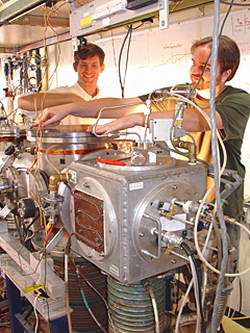
(From Atom interferometer)
UA optical sciences doctoral candidate John D. Perreault and UA assistant professor of physics Alexander D. Cronin used a sophisticated device called an atom interferometer in making the measurement. "Our research provides the first direct experimental evidence that a surface 25 nanometers away (25 billionths of a meter) causes a shift in the atom wave crests," Perreault said. "It shows that the van der Waals interaction may be a small scale force, but it's a big deal for atoms." Perreault and Cronin found that atoms closer than 25 nanometers to a surface are very strongly attracted to the surface because of the van der Waals interaction-- so strongly that the atoms are accelerated with the force of a million g's.
This new research causes an interesting dilemma not just for researchers in nanotechnology, but for science fiction writers as well, because it sets limits on imagination. When Einstein's work on relativistic physics became well established, sf writers were hard put to create believable space travel that involved accelerating a mass (like a spaceship) anywhere close to the speed of light, let alone at multiples of light speed. The arguments over whether hyperspace jumps and supralight drives are possible, or whether we will wind up using slowboats to journey to the stars, have gone on for several generations now.
When Philip K. Dick imagined the autofac in 1955 (and embryonic robots ten years later), there were no limits to how small you could imagine a nanobot to be:
The bits were in motion. Microscopic machinery, smaller than ants, smaller than pins, working energetically, purposefully - constructing something that looked like a tiny rectangle of steel."They're building," O'Neill said, awed.
(Read more about Philip K. Dick's autofac)
Dick's literary efforts preceded Richard Feynman's famous 1959 talk that kicked off the scientific pursuit of nanotechnology.
Read more here
Scroll down for more stories in the same category. (Story submitted 9/25/2005)
Follow this kind of news @Technovelgy.| Email | RSS | Blog It | Stumble | del.icio.us | Digg | Reddit |
Would
you like to contribute a story tip?
It's easy:
Get the URL of the story, and the related sf author, and add
it here.
Comment/Join discussion ( 3 )
Related News Stories - (" Engineering ")
Biomimetic Tendons From Rochu Robotics
'... the curious parallelism to animal motions.' - HG Wells, 1898.
You Will Eat The Cookies Made From Plastic...
'Our planes are going to start bringing in bales of discarded plastics...' - Rick Shelley, 1989.
ICE Buys Shock Gloves Like Batman's
What else is the Caped Crusader using?
When Colds Threaten You Can't Do This - Or Can You?
'...a hemispherical force field enclosing his head.' - FL Wallace, 1955.
Technovelgy (that's tech-novel-gee!) is devoted to the creative science inventions and ideas of sf authors. Look for the Invention Category that interests you, the Glossary, the Invention Timeline, or see what's New.

Science Fiction
Timeline
1600-1899
1900-1939
1940's 1950's
1960's 1970's
1980's 1990's
2000's 2010's
Current News
'If Anyone Is Watching Earth...'
'Our study of your race has convinced us that you are not fitted to leave your planet in the present state of your civilization.'
Epirus High-Power Microwave Defeats Drones
'...the spreading beam of the deranging ray struck them, and Then one toppled and fell. Then another.'
Cloud Of Space Rubbish From China's Long March Rocket
'Within seconds the material was spread out over fifty yards, in a matter of hours it might occupy several cubic miles of space...'
Biomimetic Tendons From Rochu Robotics
'... the curious parallelism to animal motions.'
Living Human Neuron Biological Compute Rack
'The men are dead, but their acquired wisdom lives on and I am the beneficiary.'
Martha Stewart Approves Ojai 'Living Room On Wheels'
'Young people found the driverless car admirable for petting.'
ESA's Draco To Study Heat Of Reentry
'...a synthetic which air-friction would erode.'
Buy A Galaxy? Maybe Start Smaller
'The sky is the limit' just got higher.
The United States Space Academy Is Official
'Is our orbit to Space Academy clear?'
Is There A Global Problem With Who Is Having Children?
'After twenty generations of shillyshallying...'
You Will Eat The Cookies Made From Plastic...
'Our planes are going to start bringing in bales of discarded plastics...'
It's A Giant Robot! You Reporters Have Been Warned!
'... completely forgetting the ship at sight of the awesome figure and great head of the giant Gaut...'
Birds Learn To Sing Pictures ala Frank Herbert's Distrans
'We will fight in the time of fighting.'
ElectionSim: China's 'Ender's Game' Battle Sim, Or Lem's 'Kingdom In A Box'?
'So, Ender, we will now begin your education.'
Tactile Skin Supplier Map
'What strange sensitivity! What an amazing development of science was manifested in every move and act and word of this Robot!'
Flock Stymied By 'Adversarial Fashion'
'Forget the head atop it, the legs below, feet, arms, hands. It compels erasure.'

