
Science Fiction
Dictionary
A B C D E F G H I J K L M N O P Q R S T U V W X Y Z

 |
Graphene Thermopile May Grant Predator Heat Vision To Humans

In the 1987 movie Predator, the aliens make use of slim, sophisticated devices to see the heat signatures of their opponents. Not to mention the succeeding movies in this franchise.
(Predator heat vision compilation video)
MIT researchers have been working on devices that will allow human beings to make use of heat imaging, without the bulky cryogenic cooling systems and other bulky tech that plague human devices.
To find a more practical solution, researchers at MIT, Harvard, Army Research Laboratory, and University of California, Riverside, have developed an advanced device by integrating graphene with silicon microelectromechanical systems (MEMS) to make a flexible, transparent, and low-cost device for the mid-infrared range.Testing showed it could be used to detect a person’s heat signature at room temperature (300 K or 27 degrees C/80 degrees F) without cryogenic cooling.
Future advances could make the device even more versatile. The researchers say that a thermal sensor could be based on a single layer of graphene, which would make it both transparent and flexible. Also, manufacturing could be simplified, which would bring costs down.
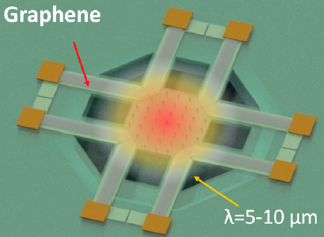
(From Schematic of graphene thermopile )
Via KurzweilAI.
Scroll down for more stories in the same category. (Story submitted 11/3/2015)
Follow this kind of news @Technovelgy.| Email | RSS | Blog It | Stumble | del.icio.us | Digg | Reddit |
Would
you like to contribute a story tip?
It's easy:
Get the URL of the story, and the related sf author, and add
it here.
Comment/Join discussion ( 0 )
Related News Stories - (" Surveillance ")
FTC: Says Ring Employees Illegally Surveilled Customers
'Then she looked up with a smile and moved closer to the camera.' - Pournelle and Niven, 1981.)
Perching Ambush Drones
'On the chest of drawers something was perched.' - Philip K. Dick, 1956.
India Ponders Always-On Smartphone Location Tracking
'It is necessary... for your own protection.' - Jack Vance, 1954.
LingYuan Vehicle Roof Drones Now Available, ala Blade Runner 2049
Accompanied by a small selection of similar ideas from science fiction.
Technovelgy (that's tech-novel-gee!) is devoted to the creative science inventions and ideas of sf authors. Look for the Invention Category that interests you, the Glossary, the Invention Timeline, or see what's New.

Science Fiction
Timeline
1600-1899
1900-1939
1940's 1950's
1960's 1970's
1980's 1990's
2000's 2010's
Current News
AI Operates An Excavator
'So far as I could see, the thing was without a directing Martian at all.'
US Army IBEX Exoskeleton Walks Troops Out Of Danger
'The suit stands up and starts walking, gripping me round the calves and waist, taking the bulk of my weight off my throbbing feet.'
Boy Makes Biomimetic Turtle Robot
't came out into plain view. Darkington glimpsed a slim body and six short legs of articulated dull metal.'
Elon Musk Wants Data Centers In Space
'Internally it’s made up of millions of components, but the most important ones are the thinking and memory parts of the Mind proper.'
Origin F1 Humanoid Robot's Facial Skin
'I could look down at that face of carefully molded synthetic rubber, tinted the exact shade of the doctor's living flesh.'
Grok And The City Fathers From 'Cities In Flight' By James Blish
'Chris, the City Fathers are not interested in your welfare; I suppose you know that. They're interested in only one thing: the survival of the city.'
Why Not Move A Warehouse District?
'Did you never see a moving house before?'
Will An AI Found A New Religion?
'You must decide how you will worship Me.'
Terraformer Industries Make Methane
'Drake was the young spatial engineer he employed to terraform the little rock...'
I Need An Outdoor Spherical Display
'Usually a spherical display hovered in the centre...'
Worm Disrupts Physics Simulations Undetected For A Decade
'It diverts integers of the data, the fundamental message-units, so that they no longer agree.'
Muxcard Redditor's DIY Credit Card-Sized Computer
It's a computer, but just barely.
'Soft Assembly' Fashions That Fashion Themselves On The Wearer
'Clothes are no longer made from dead fibers of fixed color and texture that can approximate only crudely to the vagrant human figure...'
Orwell's Nightmare Of AI-Written Novels Comes To Pass
'Books were just a commodity that had to be produced, like jam or bootlaces.'
ISS Plagued By Leak - Again!
'There were perhaps a dozen bladder-like objects in the tunnel...'
Ridiculous 'Ghost Murmur' Tech Still Science Fiction
'...it rears and spreads its fan. It can pick one man out of a crowd.'

