
Science Fiction
Dictionary
A B C D E F G H I J K L M N O P Q R S T U V W X Y Z

 |
Kilometer-Wide Rotating Space Station On One Rocket

Is it possible to launch enormous (i.e. kilometer-wide) rotating space stations with a single rocket launch?
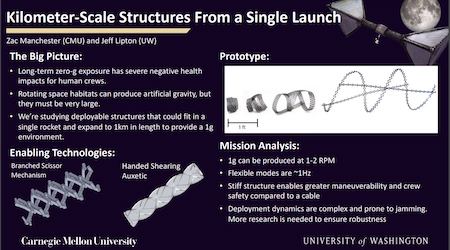
(Slide from a NIAC presentation)
Artificial gravity remains the stuff of science fiction. But dealing with no gravity causes significant problems in many astronauts, ranging from bone deterioration to loss of sight. An alternative method that might eliminate some of these problems is “simulated gravity,” which uses a spinning structure to create centrifugal force that would have the same effect on the body as gravity would. Whether or not this would solve the problems caused by lack of gravity remains to be seen. Still, NASA seems keen on the idea – to the tune of a $600,000 NASA Institute for Advanced Concepts (NIAC) Phase II grant to a team from Carnegie Mellon University (CMU) and the University of Washington (UW) who is looking to develop a structure that can simulate full Earth gravity and be launched in a single rocket.The project in question is “Kilometer-Scale Space Structure from a Single Launch,” which was initially admitted to the NIAC program last year. Over the past year, they successfully completed a Phase I project where they “analyze[d] a mission concept analogous to the Lunar Gateway” that could deploy into a kilometer-long structure. Having met NASA’s expectations as part of that program, the team, headed by professor Zac Manchester of CMU and Jeffery Lipton of UW, were recently accepted as 2022 NIAC fellows.
The idea of a rotating space station that provides artificial gravity goes back to at least 1928. This same idea is stated in detail in The Problem of Space Travel - The Rocket Motor, written by Herman Potočnik (pseudonym Hermann Noordung) in 1928. The book was published in German in 1929, and was translated into Russian in 1935; it was finally translated into english by NASA in 1999).
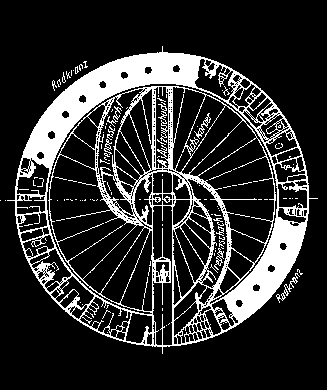
(Herman Potočnik Habitat Wheel (author's illustration))
These conditions are, however, best fulfilled when the station is laid out in the shape of a large wheel as previously indicated: the rim of the wheel is composed out of cells and has the form of a ring braced by wire spokes towards the axis. Its interior is separated into individual rooms by partitions; all rooms are accessible from a wide corridor going around the entire station. There are individual rooms, larger sleeping bays, work and study areas, mess hall, laboratory, workshop, dark room, etc., as well as the usual utility areas, such as a kitchen, bath room, laundry room and similar areas. All rooms are furnished with modern day comforts; even cold and warm water lines are available. In general, the rooms are similar to those of a modern ship. They can be furnished just like on Earth because an almost normal, terrestrial gravitational state exists in these rooms...
Science fiction writer Jack Williamson made use of the idea in his 1931 story The Prince of Space:
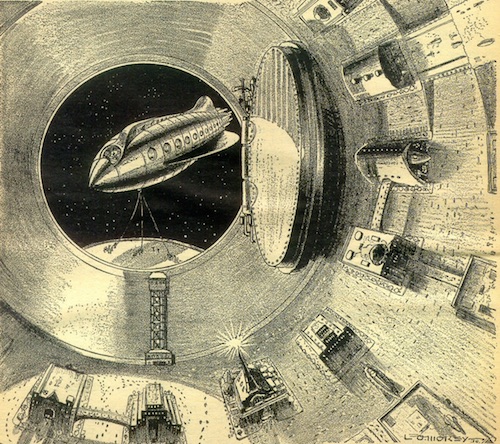
(The city of space by Jack Williamson)"They were, Bill saw, at the center of an enormous cylinder. The sides, half a mile away, above and below them, were covered with buildings along neat, tree-bordered streets, scattered with green lawns, tiny gardens, and bits of wooded park. It seemed very strange to Bill, to see these endless streets about the inside of a tube, so that one by walking a little over three miles in one direction would arrive again at the starting point, in the same way that one gets back to the starting point after going around the earth in one direction."
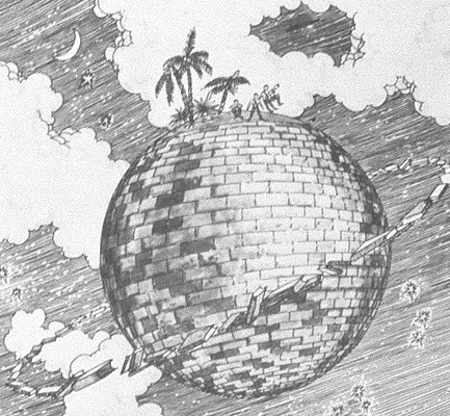
Launching huge structures at one time is no big strain (for the imagination, at least) for science fiction authors. Read about the flywheel launcher sufficient to send a brick moon into space in Edward Everett Hale's 1869 story The Brick Moon:
('The Brick Moon' by Edward Everett Hale)"It was not to be by any of your sudden explosions. It was to be done as all great things are done,--by the gradual and silent accumulation of power. You all know that a flywheel--heavy, very heavy on the circumference, light, very light within it--was made to save up power, from the time when it was produced to the time when it was wanted. Yes? Then, before we began even to build the moon, before we even began to make the brick, we would build two gigantic fly-wheels, the diameter of each should be "ever so great," the circumference heavy beyond all precedent, and thundering strong, so that no temptation might burst it. They should revolve, their edges nearly touching, in opposite directions, for years, if it were necessary, to accumulate power, driven by some waterfall now wasted to the world."
Scroll down for more stories in the same category. (Story submitted 3/7/2022)
Follow this kind of news @Technovelgy.| Email | RSS | Blog It | Stumble | del.icio.us | Digg | Reddit |
Would
you like to contribute a story tip?
It's easy:
Get the URL of the story, and the related sf author, and add
it here.
Comment/Join discussion ( 0 )
Related News Stories - (" Space Tech ")
'If Anyone Is Watching Earth...'
'Our study of your race has convinced us that you are not fitted to leave your planet in the present state of your civilization.' - Arthur C. Clarke, 1946.
Cloud Of Space Rubbish From China's Long March Rocket
'Within seconds the material was spread out over fifty yards, in a matter of hours it might occupy several cubic miles of space...'
ESA's Draco To Study Heat Of Reentry
'...a synthetic which air-friction would erode.' - EE Doc Smith, 1934.
The United States Space Academy Is Official
'Is our orbit to Space Academy clear?' - Carey Rockwell
Technovelgy (that's tech-novel-gee!) is devoted to the creative science inventions and ideas of sf authors. Look for the Invention Category that interests you, the Glossary, the Invention Timeline, or see what's New.

Science Fiction
Timeline
1600-1899
1900-1939
1940's 1950's
1960's 1970's
1980's 1990's
2000's 2010's
Current News
'If Anyone Is Watching Earth...'
'Our study of your race has convinced us that you are not fitted to leave your planet in the present state of your civilization.'
Epirus High-Power Microwave Defeats Drones
'...the spreading beam of the deranging ray struck them, and Then one toppled and fell. Then another.'
Cloud Of Space Rubbish From China's Long March Rocket
'Within seconds the material was spread out over fifty yards, in a matter of hours it might occupy several cubic miles of space...'
Biomimetic Tendons From Rochu Robotics
'... the curious parallelism to animal motions.'
Living Human Neuron Biological Compute Rack
'The men are dead, but their acquired wisdom lives on and I am the beneficiary.'
Martha Stewart Approves Ojai 'Living Room On Wheels'
'Young people found the driverless car admirable for petting.'
ESA's Draco To Study Heat Of Reentry
'...a synthetic which air-friction would erode.'
Buy A Galaxy? Maybe Start Smaller
'The sky is the limit' just got higher.
The United States Space Academy Is Official
'Is our orbit to Space Academy clear?'
Is There A Global Problem With Who Is Having Children?
'After twenty generations of shillyshallying...'
You Will Eat The Cookies Made From Plastic...
'Our planes are going to start bringing in bales of discarded plastics...'
It's A Giant Robot! You Reporters Have Been Warned!
'... completely forgetting the ship at sight of the awesome figure and great head of the giant Gaut...'
Birds Learn To Sing Pictures ala Frank Herbert's Distrans
'We will fight in the time of fighting.'
ElectionSim: China's 'Ender's Game' Battle Sim, Or Lem's 'Kingdom In A Box'?
'So, Ender, we will now begin your education.'
Tactile Skin Supplier Map
'What strange sensitivity! What an amazing development of science was manifested in every move and act and word of this Robot!'
Flock Stymied By 'Adversarial Fashion'
'Forget the head atop it, the legs below, feet, arms, hands. It compels erasure.'

