
Science Fiction
Dictionary
A B C D E F G H I J K L M N O P Q R S T U V W X Y Z
Latest By
Category:
Armor
Artificial
Intelligence
Biology
Clothing
Communication
Computers
Culture
Data Storage
Displays
Engineering
Entertainment
Food
Input Devices
Lifestyle
Living Space
Manufacturing
Material
Media
Medical
Miscellaneous
Robotics
Security
Space Tech
Spacecraft
Surveillance
Transportation
Travel
Vehicle
Virtual
Person
Warfare
Weapon
Work
"I received a nice letter the other day from the Dalai Lama. He had read 'The Nine Billion Names of God'. It is about a computer at a Tibetan monastery."
- Arthur C. Clarke

 |
| Steam Cart Horse | ||
| A steam-powered autonomaton horse to pull a wagon or cart. |

| “Musha, my God, an’ what do ye call it?”
Frank Reade looked up with a pleasant smile, as a brick-colored head was thrust into the half-open doorway of the wood-shed, where he was hard at work putting the several parts of his invention together. “Call it!” said the sixteen-year-old genius, with a proud glance at his wonderful idea; “why, I call it a steam horse.” “A harse, is it?” “It is,” said Frank. “Wid stale an’ iron legs, an’ a big copper belly on him?” “You’re right.” “An’ can he walk?” “Yes, and run too.”
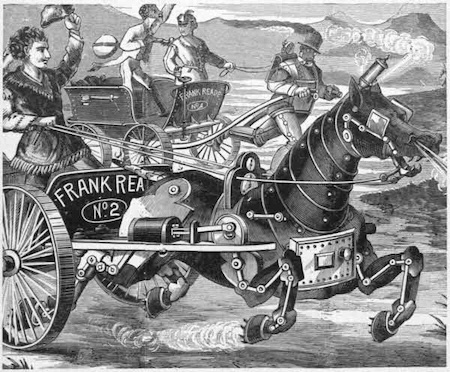 (Frank Reade and his Steam Horse)
“Arrah, it’s a jaynus ye are,” he said as he looked at Frank’s invention. “An’ do ye mane to tell me that you constructed that conthrivance all out of yer own head, me gossoon?”
|
| Technovelgy from Frank Reade and his Steam Horse,
by Harry Enton. Published by Frank Tousey in 1883 Additional resources -
|
Compare to the steam horse from Le Monde Tel Qu'il Sera (The World As It Shall Be) (1846) by Emile Souvestre, the robass from The Quest for Saint Aquin (1951) by Anthony Boucher, the robotic horse - Faithful Cybernetic Companion from The Warlock in Spite of Himself (1969) by Christopher Stasheff and the chevaline from The Diamond Age (1995) by Neal Stephenson.
Comment/Join this discussion ( 0 ) | RSS/XML | Blog This |
Additional
resources:
More Ideas
and Technology from Frank Reade and his Steam Horse
More Ideas
and Technology by Harry Enton
Tech news articles related to Frank Reade and his Steam Horse
Tech news articles related to works by Harry Enton
| Epirus High-Power Microwave Defeats Drones |
| It's A Giant Robot! You Reporters Have Been Warned! |
| Tactile Skin Supplier Map |
| Robot Bees 3D Printed By Festo |
Want to Contribute an
Item?
It's easy:
Get the name of the item, a
quote, the book's name and the author's name, and Add
it here.
| <Previous | Next> |
|
|
|
Technovelgy (that's tech-novel-gee!) is devoted to the creative science inventions and ideas of sf authors. Look for the Invention Category that interests you, the Glossary, the Science Fiction Invention Timeline, or see what's New.
|

Science Fiction
Timeline
1600-1899
1900-1939
1940's 1950's
1960's 1970's
1980's 1990's
2000's 2010's
'Our study of your race has convinced us that you are not fitted to leave your planet in the present state of your civilization.'
'...the spreading beam of the deranging ray struck them, and Then one toppled and fell. Then another.'
'Within seconds the material was spread out over fifty yards, in a matter of hours it might occupy several cubic miles of space...'
'The men are dead, but their acquired wisdom lives on and I am the beneficiary.'
'Young people found the driverless car admirable for petting.'
'After twenty generations of shillyshallying...'

