
Science Fiction
Dictionary
A B C D E F G H I J K L M N O P Q R S T U V W X Y Z

 |
X-Ray Pulsar 'Beacons' To Guide Spacecraft

X-Ray pulsars can be used to triangulate the position of space craft to within a few kilometers, according to scientists at the Max-Planck Institute for Extraterrestrial Physics in Garching, Germany.
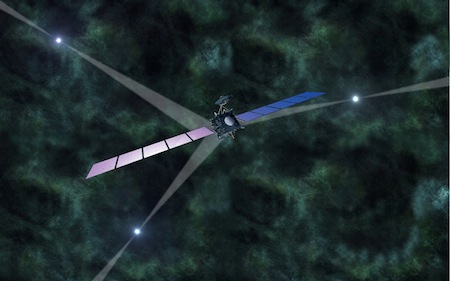
(Artist’s impression of Rosetta, if it navigated in deep space using pulsar signals)
Werner Becker and his team are developing a novel navigation technology for spacecraft based on the regular emission of X-ray light from pulsars. Their periodic signals have timing stabilities comparable to atomic clocks and provide characteristic time signatures that can be used as natural navigation beacons, similar to the use of GPS satellites for navigation on Earth.By comparing the arrival times of the pulses measured on board the navigator spacecraft with those predicted at a reference location, the spacecraft position can be determined with an accuracy of few kilometers, everywhere in the Solar System and far beyond.
[Becker:] “These X-ray beacons could augment the existing GPS/Galileo satellite navigation systems and provide autonomous navigation for interplanetary space probes and future manned missions to Mars.”
Science fiction writers of the 1950's were fascinated by this idea. In his 1952 story Troubled Star, George O. Smith described space beacons:
"And what is a beacon?""It is a phenomenon caused by the Doppler effect when traveling at galactic speeds. In this case, when coming through this rift at fifteen hundred light years per hour, a three-day variable star will appear to the observer as a rapidly blinking light..."
"We use the three-day variable to denote the galactic travel lanes. Very effective.
(Read more about Smith's space beacon)
In his 1956 story The Repairman, Murray Leinster described a hyperspace beacon:
Every beacon has a code signal as part of its radiation and represents a measurable point in hyperspace. Triangulation and quadrature works for navigation - only it follows its own rules.For a hyperspace jump, you need at least four beacons for an accurate fix.
(Read more about Harrison's hyperspace beacon)
In 1980, Star Trek Maps was published; it consisted of a set of four maps and an Introduction to Navigation booklet. In the accompanying pamphlet, they described the standard navigation system using "sub-space beacons", and then described the emergency system that used pulsars as a GPS system. It included the real equations as well.
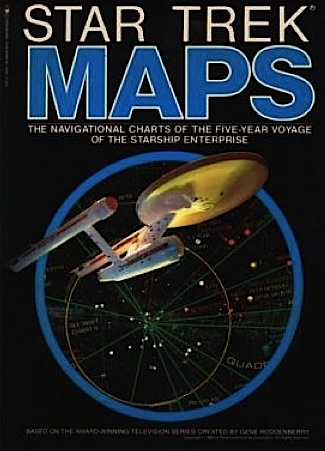
(Star Trek Maps: galactic coordinates and basic vector calculus)
Via AstroBio; thanks to Winchell Chung (aka @nyrath) of Project Rho.
Scroll down for more stories in the same category. (Story submitted 3/31/2012)
Follow this kind of news @Technovelgy.| Email | RSS | Blog It | Stumble | del.icio.us | Digg | Reddit |
Would
you like to contribute a story tip?
It's easy:
Get the URL of the story, and the related sf author, and add
it here.
Comment/Join discussion ( 0 )
Related News Stories - (" Space Tech ")
'If Anyone Is Watching Earth...'
'Our study of your race has convinced us that you are not fitted to leave your planet in the present state of your civilization.' - Arthur C. Clarke, 1946.
Cloud Of Space Rubbish From China's Long March Rocket
'Within seconds the material was spread out over fifty yards, in a matter of hours it might occupy several cubic miles of space...'
ESA's Draco To Study Heat Of Reentry
'...a synthetic which air-friction would erode.' - EE Doc Smith, 1934.
The United States Space Academy Is Official
'Is our orbit to Space Academy clear?' - Carey Rockwell
Technovelgy (that's tech-novel-gee!) is devoted to the creative science inventions and ideas of sf authors. Look for the Invention Category that interests you, the Glossary, the Invention Timeline, or see what's New.

Science Fiction
Timeline
1600-1899
1900-1939
1940's 1950's
1960's 1970's
1980's 1990's
2000's 2010's
Current News
'If Anyone Is Watching Earth...'
'Our study of your race has convinced us that you are not fitted to leave your planet in the present state of your civilization.'
Epirus High-Power Microwave Defeats Drones
'...the spreading beam of the deranging ray struck them, and Then one toppled and fell. Then another.'
Cloud Of Space Rubbish From China's Long March Rocket
'Within seconds the material was spread out over fifty yards, in a matter of hours it might occupy several cubic miles of space...'
Biomimetic Tendons From Rochu Robotics
'... the curious parallelism to animal motions.'
Living Human Neuron Biological Compute Rack
'The men are dead, but their acquired wisdom lives on and I am the beneficiary.'
Martha Stewart Approves Ojai 'Living Room On Wheels'
'Young people found the driverless car admirable for petting.'
ESA's Draco To Study Heat Of Reentry
'...a synthetic which air-friction would erode.'
Buy A Galaxy? Maybe Start Smaller
'The sky is the limit' just got higher.
The United States Space Academy Is Official
'Is our orbit to Space Academy clear?'
Is There A Global Problem With Who Is Having Children?
'After twenty generations of shillyshallying...'
You Will Eat The Cookies Made From Plastic...
'Our planes are going to start bringing in bales of discarded plastics...'
It's A Giant Robot! You Reporters Have Been Warned!
'... completely forgetting the ship at sight of the awesome figure and great head of the giant Gaut...'
Birds Learn To Sing Pictures ala Frank Herbert's Distrans
'We will fight in the time of fighting.'
ElectionSim: China's 'Ender's Game' Battle Sim, Or Lem's 'Kingdom In A Box'?
'So, Ender, we will now begin your education.'
Tactile Skin Supplier Map
'What strange sensitivity! What an amazing development of science was manifested in every move and act and word of this Robot!'
Flock Stymied By 'Adversarial Fashion'
'Forget the head atop it, the legs below, feet, arms, hands. It compels erasure.'

