
Science Fiction
Dictionary
A B C D E F G H I J K L M N O P Q R S T U V W X Y Z

 |
PCASS And The Original Handheld Lie Detector

The Preliminary Credibility Assessment Screening System (PCASS) is a handheld lie detector to be given to US Army soldiers in Afghanistan this month.
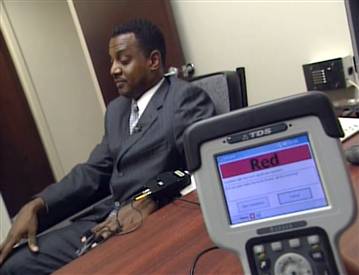
( Preliminary Credibility Assessment Screening System (PCASS) )
The defense department admits that the device is not perfect, but insists that it can help save American lives by screening local police officers, interpreters and allied forces for access to U.S. military bases, and by helping narrow the list of suspects after a roadside bombing.
However, the National Academy of Sciences has this to say about lie detectors:
"Almost a century of research in scientific psychology and physiology provides little basis for the expectation that a polygraph test could have extremely high accuracy... The inherent ambiguity of the physiological measures used in the polygraph suggest that further investments in improving polygraph technique and interpretation will bring only modest improvements in accuracy."
When asked specifically about the PCASS device, the lead author of the study, statistics professor Stephen E. Fienberg, stated:
"I don't understand how anybody could think that this is ready for deployment. Sending these instruments into the field in Iraq and Afghanistan without serious scientific assessment, and for use by untrained personnel, is a mockery of what we advocated in our report."
The first work on the idea of a lie detector was done by William Moulton Marston during WWI; he worked on a systolic blood-pressure test that could be used to detect deception.
He also created an illustrated version of a special handheld lie detector in a well-known fictional work; see a brief video of this device in action.
(The original handheld lie detector)
The Lasso of Truth (also called the Magic Lasso or Golden Lasso) forces a captured person to tell the truth in the Wonder Woman comic series.
Via New anti-terror weapon: Hand-held lie detector.
Scroll down for more stories in the same category. (Story submitted 4/12/2008)
Follow this kind of news @Technovelgy.| Email | RSS | Blog It | Stumble | del.icio.us | Digg | Reddit |
Would
you like to contribute a story tip?
It's easy:
Get the URL of the story, and the related sf author, and add
it here.
Comment/Join discussion ( 1 )
Related News Stories - (" Security ")
Flimmer Navy Drone Flies And Swims
Launch the Flying Sub!
Indian Court Says Brain Scan Proves Murder
Using a test called Brain Electrical Oscillations Signature, an Indian court convicts a woman based on her brain contents.
Background Draw-a-Secret (BDAS) Makes Graphical Passwords
Interesting security technique that takes advantage of the greater ease with which we all recall pictures, as opposed to the kind of alphanumeric strings IT techs want us to use for passwords.
ID-U Biometrics Eye Tracking Signature
Interesting new method of secure identification gathers a unique response to stimulus each time; old data cannot be copied and presented to the system.
Technovelgy (that's tech-novel-gee!) is devoted to the creative science inventions and ideas of sf authors. Look for the Invention Category that interests you, the Glossary, the Invention Timeline, or see what's New.

Science Fiction
Timeline
1600-1899
1900-1939
1940's 1950's
1960's 1970's
1980's 1990's
2000's 2010's
Current News
'If Anyone Is Watching Earth...'
'Our study of your race has convinced us that you are not fitted to leave your planet in the present state of your civilization.'
Epirus High-Power Microwave Defeats Drones
'...the spreading beam of the deranging ray struck them, and Then one toppled and fell. Then another.'
Cloud Of Space Rubbish From China's Long March Rocket
'Within seconds the material was spread out over fifty yards, in a matter of hours it might occupy several cubic miles of space...'
Biomimetic Tendons From Rochu Robotics
'... the curious parallelism to animal motions.'
Living Human Neuron Biological Compute Rack
'The men are dead, but their acquired wisdom lives on and I am the beneficiary.'
Martha Stewart Approves Ojai 'Living Room On Wheels'
'Young people found the driverless car admirable for petting.'
ESA's Draco To Study Heat Of Reentry
'...a synthetic which air-friction would erode.'
Buy A Galaxy? Maybe Start Smaller
'The sky is the limit' just got higher.
The United States Space Academy Is Official
'Is our orbit to Space Academy clear?'
Is There A Global Problem With Who Is Having Children?
'After twenty generations of shillyshallying...'
You Will Eat The Cookies Made From Plastic...
'Our planes are going to start bringing in bales of discarded plastics...'
It's A Giant Robot! You Reporters Have Been Warned!
'... completely forgetting the ship at sight of the awesome figure and great head of the giant Gaut...'
Birds Learn To Sing Pictures ala Frank Herbert's Distrans
'We will fight in the time of fighting.'
ElectionSim: China's 'Ender's Game' Battle Sim, Or Lem's 'Kingdom In A Box'?
'So, Ender, we will now begin your education.'
Tactile Skin Supplier Map
'What strange sensitivity! What an amazing development of science was manifested in every move and act and word of this Robot!'
Flock Stymied By 'Adversarial Fashion'
'Forget the head atop it, the legs below, feet, arms, hands. It compels erasure.'

