
Science Fiction
Dictionary
A B C D E F G H I J K L M N O P Q R S T U V W X Y Z

 |
Robot Brain Grows As It Learns

This robot's brain grows in size as its physical complexity increases; the multi-legged robot has neural net software that grows by assigning new neuron clusters on top of existing structures as new limbs are attached. An incremental evolutionary algorithm (IEA) gives it the ability to add new parts to its brain.
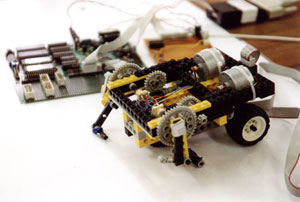
(Robot brain grows as the robot's complexity grows)
In human brains, the earliest structure, the reptilian brain, is mostly focused on the survival of the organism, controlling muscles, balance and autonomic functions. It is covered by the limbic brain, which records experience to create emotion and facilitates learning. Finally, the overlying neocortex is responsible for human culture, allowing the development of language and abstract thought.
Artificial intelligence engineer Christopher MacLeod and his colleagues at the Robert Gordon University in Aberdeen, UK, have arranged for the robot to evolve in hours. It accomplishes in this short time what animals have done over hundreds of millions of years.
The team started with a simple robot the size of a paperback book, with two rotatable pegs for legs that could be turned by motors through 180 degrees. They then gave the robot's six-neuron control system its primary command - to travel as far as possible in 1000 seconds. The software then set to work evolving the fastest form of locomotion to fulfil this task."It fell over mostly, in a puppyish kind of way," says MacLeod. "But then it started moving forward and not falling over straight away - and then it got better and better until it could eventually hop along the bench like a mudskipper."
When the IEA realises that its evolutions are no longer improving the robot's speed it freezes the neural network it has evolved, denying it the ability to evolve further. That network knows how to work the peg legs - and it will continue to do so.
At this point, it is just like any other evolved robot: it would be unable to cope with the addition of knee-like joints, say, or more legs. But unlike conventional EAs, the IEA is sensitive to a sudden inability to live up to its primary command. So when the team fixed jointed legs to their robot's pegs, the software "realises" that it has to learn how to walk all over again. To do this, it automatically assigns itself fresh neurons to learn how to control its new legs.
This innocent tale of machine evolution reminds me of a somewhat darker version provided by Philip K. Dick in his 1953 short story Second Variety:
"Interesting, isn't it?""What?"
"This, the new types. The new varieties of claws. We're completely at their mercy, aren't we? By now they've probably gotten into the UN lines, too. It makes me wonder if we're not seeing the beginning of a new species. The new species. Evolution. The race to come after man." (Read more about Dick's claws)
Update: See also the Vulcan 3 computer from Dick's 1960 novel Vulcan's Hammer for an example of a large computer system that modifies itself extensively. End update.
From New Scientist. See also this paper The Development of Modular Evolutionary Networks for Quadrupedal Locomotion [pdf] and this article from Electronics World - Minds for Robots [pdf].
Scroll down for more stories in the same category. (Story submitted 2/9/2009)
Follow this kind of news @Technovelgy.| Email | RSS | Blog It | Stumble | del.icio.us | Digg | Reddit |
Would
you like to contribute a story tip?
It's easy:
Get the URL of the story, and the related sf author, and add
it here.
Comment/Join discussion ( 3 )
Related News Stories - (" Robotics ")
Epirus High-Power Microwave Defeats Drones
'...the spreading beam of the deranging ray struck them, and Then one toppled and fell. Then another.' - Ray Cummings, 1931.
It's A Giant Robot! You Reporters Have Been Warned!
'... completely forgetting the ship at sight of the awesome figure and great head of the giant Gaut...'
Tactile Skin Supplier Map
'What strange sensitivity! What an amazing development of science was manifested in every move and act and word of this Robot!' - Ray Cummings, 1931.
Robot Bees 3D Printed By Festo
'At first I was struck by the large size of these bees..' - Ernst Junger, 1957.
Technovelgy (that's tech-novel-gee!) is devoted to the creative science inventions and ideas of sf authors. Look for the Invention Category that interests you, the Glossary, the Invention Timeline, or see what's New.

Science Fiction
Timeline
1600-1899
1900-1939
1940's 1950's
1960's 1970's
1980's 1990's
2000's 2010's
Current News
'If Anyone Is Watching Earth...'
'Our study of your race has convinced us that you are not fitted to leave your planet in the present state of your civilization.'
Epirus High-Power Microwave Defeats Drones
'...the spreading beam of the deranging ray struck them, and Then one toppled and fell. Then another.'
Cloud Of Space Rubbish From China's Long March Rocket
'Within seconds the material was spread out over fifty yards, in a matter of hours it might occupy several cubic miles of space...'
Biomimetic Tendons From Rochu Robotics
'... the curious parallelism to animal motions.'
Living Human Neuron Biological Compute Rack
'The men are dead, but their acquired wisdom lives on and I am the beneficiary.'
Martha Stewart Approves Ojai 'Living Room On Wheels'
'Young people found the driverless car admirable for petting.'
ESA's Draco To Study Heat Of Reentry
'...a synthetic which air-friction would erode.'
Buy A Galaxy? Maybe Start Smaller
'The sky is the limit' just got higher.
The United States Space Academy Is Official
'Is our orbit to Space Academy clear?'
Is There A Global Problem With Who Is Having Children?
'After twenty generations of shillyshallying...'
You Will Eat The Cookies Made From Plastic...
'Our planes are going to start bringing in bales of discarded plastics...'
It's A Giant Robot! You Reporters Have Been Warned!
'... completely forgetting the ship at sight of the awesome figure and great head of the giant Gaut...'
Birds Learn To Sing Pictures ala Frank Herbert's Distrans
'We will fight in the time of fighting.'
ElectionSim: China's 'Ender's Game' Battle Sim, Or Lem's 'Kingdom In A Box'?
'So, Ender, we will now begin your education.'
Tactile Skin Supplier Map
'What strange sensitivity! What an amazing development of science was manifested in every move and act and word of this Robot!'
Flock Stymied By 'Adversarial Fashion'
'Forget the head atop it, the legs below, feet, arms, hands. It compels erasure.'

