
Science Fiction
Dictionary
A B C D E F G H I J K L M N O P Q R S T U V W X Y Z

 |
Quaise Uses Beams Of Energy To Dig Geothermal Wells

Exotic Quaise drills deep into the earth with beams of light.
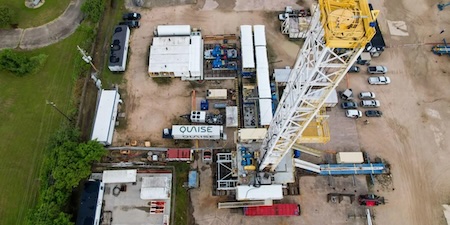
(Quase Drills With Beams of Light)
The company is building an exploration well this year and plans to begin drilling production wells (those that can eventually be used to generate electricity) in 2026. That pilot project will reach about 20 megawatts of power with the first few wells, operating on rock that’s around 350 °C. The company plans to have it operational as early as 2028.Quaise’s strategy with the Oregon project is to show that it can use super-hot rocks to produce geothermal power efficiently, says CEO Carlos Araque. After it fires up the plant and begins producing electricity, the company can go back in and deepen the holes with millimeter-wave drilling in the future, he adds.
This amazing technical feat reminds me why I often will add something to my database that seems patently impossible, or just too science-fictional to ever become real.
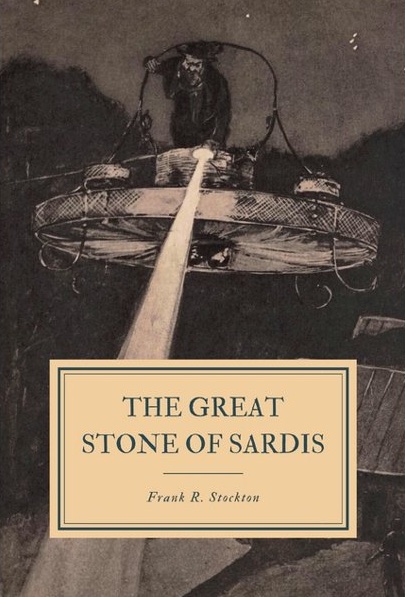
In 1897, science fiction writer Frank Stockton wrote The Great Stone of Sardis, in which he described a method for drilling deep into the earth using a penetrating ray:
The Artesian ray, of which these two spoke, was an invention upon which Roland Clewe had been experimenting for a long time, and which was and had been the object of his labors and studies while in Europe. In the first decade of the century it had been generally supposed that the X ray, or cathode ray, had been developed and applied to the utmost extent of its capability. It was used in surgery and in mechanical arts, and in many varieties of scientific operations, but no considerable advance in its line of application had been recognized for a quarter of a century. But Roland Clewe had come to believe in the existence of a photic force, somewhat similar to the cathode ray, but of infinitely greater significance and importance to the searcher after physical truth. Simply described, his discovery was a powerful ray produced by a new combination of electric lights, which would penetrate down into the earth, passing through all substances which it met in its way, and illuminating and disclosing everything through which it passed.
(The photic borer from 'The Great Stone of Sardis' by Frank Stockton)After making many minor trials of the force and powers of his light, Roland Clewe had undertaken the construction of a massive apparatus, by which he believed a ray could be generated which, little by little, perhaps foot by foot, would penetrate into the earth and light up everything between the farthest point it had attained and the lenses of his machine. That is to say, he hoped to produce a long hole of light about three feet in diameter and as deep as it was possible to make it descend, in which he could see all the various strata and deposits of which the earth is composed. How far he could send down this piercing cylinder of light he did not allow himself to consider...
(Read more about the Photic Borer (Artesian Ray))
Scroll down for more stories in the same category. (Story submitted 7/1/2025)
Follow this kind of news @Technovelgy.| Email | RSS | Blog It | Stumble | del.icio.us | Digg | Reddit |
Would
you like to contribute a story tip?
It's easy:
Get the URL of the story, and the related sf author, and add
it here.
Comment/Join discussion ( 0 )
Related News Stories - (" Engineering ")
Biomimetic Tendons From Rochu Robotics
'... the curious parallelism to animal motions.' - HG Wells, 1898.
You Will Eat The Cookies Made From Plastic...
'Our planes are going to start bringing in bales of discarded plastics...' - Rick Shelley, 1989.
ICE Buys Shock Gloves Like Batman's
What else is the Caped Crusader using?
When Colds Threaten You Can't Do This - Or Can You?
'...a hemispherical force field enclosing his head.' - FL Wallace, 1955.
Technovelgy (that's tech-novel-gee!) is devoted to the creative science inventions and ideas of sf authors. Look for the Invention Category that interests you, the Glossary, the Invention Timeline, or see what's New.

Science Fiction
Timeline
1600-1899
1900-1939
1940's 1950's
1960's 1970's
1980's 1990's
2000's 2010's
Current News
'If Anyone Is Watching Earth...'
'Our study of your race has convinced us that you are not fitted to leave your planet in the present state of your civilization.'
Epirus High-Power Microwave Defeats Drones
'...the spreading beam of the deranging ray struck them, and Then one toppled and fell. Then another.'
Cloud Of Space Rubbish From China's Long March Rocket
'Within seconds the material was spread out over fifty yards, in a matter of hours it might occupy several cubic miles of space...'
Biomimetic Tendons From Rochu Robotics
'... the curious parallelism to animal motions.'
Living Human Neuron Biological Compute Rack
'The men are dead, but their acquired wisdom lives on and I am the beneficiary.'
Martha Stewart Approves Ojai 'Living Room On Wheels'
'Young people found the driverless car admirable for petting.'
ESA's Draco To Study Heat Of Reentry
'...a synthetic which air-friction would erode.'
Buy A Galaxy? Maybe Start Smaller
'The sky is the limit' just got higher.
The United States Space Academy Is Official
'Is our orbit to Space Academy clear?'
Is There A Global Problem With Who Is Having Children?
'After twenty generations of shillyshallying...'
You Will Eat The Cookies Made From Plastic...
'Our planes are going to start bringing in bales of discarded plastics...'
It's A Giant Robot! You Reporters Have Been Warned!
'... completely forgetting the ship at sight of the awesome figure and great head of the giant Gaut...'
Birds Learn To Sing Pictures ala Frank Herbert's Distrans
'We will fight in the time of fighting.'
ElectionSim: China's 'Ender's Game' Battle Sim, Or Lem's 'Kingdom In A Box'?
'So, Ender, we will now begin your education.'
Tactile Skin Supplier Map
'What strange sensitivity! What an amazing development of science was manifested in every move and act and word of this Robot!'
Flock Stymied By 'Adversarial Fashion'
'Forget the head atop it, the legs below, feet, arms, hands. It compels erasure.'

