
Science Fiction
Dictionary
A B C D E F G H I J K L M N O P Q R S T U V W X Y Z

 |
Virtual Milgram Experiment

Researcher Mel Slater, who works at the Catalan Polytechnic University in Barcelona, Spain, and at University College London, UK, has set up a virtual reality version of the famous Stanley Milgram experiment of the 1960's.
In Milgram's earlier version, volunteers were told by an authority figure to deliver electric shocks to another person as punishment during a "test." No actual shocks were given; the "punished" person faked increasingly emotional reactions. Sixty-five percent of the volunteers administered shocks that could be fatal, astounding a generation of psychologists.
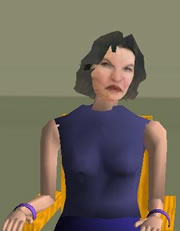
(Shocks given to virtual woman)
In Slater's virtual version, volunteers in an immersive virtual environment administered "shocks" to a virtual woman character. Half of the volunteers could see the woman character; the others interacted only with text. The context of the experiment was that the virtual woman was answering questions in a test. When she gave an incorrect answer, volunteers were told to give her shocks of increasing voltage as time went on. The virtual woman responded with cries of pain and protest.
Despite the fact that all volunteers knew that the subject of the experiment was not a real human being, they typically became more anxious as the experiment proceeded. Measures of stress, like heart rate and palm sweatiness, increased for many volunteers. About fifty percent of those who could see the woman character confided after the experiment that they thought about quitting, and several of them actually did. Volunteers who could not see the woman character were more likely to administer shocks of maximum voltage than those who could see her.
Why would people care about a virtual character in a clearly contrived experiment? It appears that the emotional brain of the human volunteers didn't quite get the message that this was only virtual reality.
Milgram's classic experiment was about obedience to authority - how volunteers tended to obey an authority figure despite the warnings of conscience. He wrote:
Stark authority was pitted against the [participants'] strongest moral imperatives against hurting others, and, with the [participants'] ears ringing with the screams of the victims, authority won more often than not. The extreme willingness of adults to go to almost any lengths on the command of an authority constitutes the chief finding of the study and the fact most urgently demanding explanation.
In Slater's study, the remarkable thing is that the virtual reality setup appears to provide an accurate assessment of the body's anxious reaction to a morally conflicted situation. According to Slater, it does this without violating the ethics of experimenters; Milgram's experiment resulted in a year-long delay in his application for membership to the American Psychological Association due to ethics questions. Other psychologists have contested this, saying that even when this experiment is performed in a virtual environment, it still has an ethically troubling effect on participants.
I'm curious about what this experiment says about the different uses of virtual violence in science fiction. In Star Trek: The Next Generation, there are long sequences that take place in the holodeck - a virtual reality environment. In at least one episode, Captain Picard "guns down" virtual figures without appearing anxious. However, all of the human characters are very solicitous of the "feelings" of Commander Data, an android robot, and are concerned when he is harmed.
I also wonder about games like Grand Theft Auto, in which violence toward virtual characters is expected and rewarded. Do people self-select when they choose to buy or play the game? Are there friends of these self-selected players who become to anxious to continue playing when they see what happens to the virtual characters? From Virtual reality shocker.
Scroll down for more stories in the same category. (Story submitted 12/26/2006)
Follow this kind of news @Technovelgy.| Email | RSS | Blog It | Stumble | del.icio.us | Digg | Reddit |
Would
you like to contribute a story tip?
It's easy:
Get the URL of the story, and the related sf author, and add
it here.
Comment/Join discussion ( 2 )
Related News Stories - (" Culture ")
Buy A Galaxy? Maybe Start Smaller
'The sky is the limit' just got higher.
Is There A Global Problem With Who Is Having Children?
'After twenty generations of shillyshallying...' - CM Kornbluth, 1950.
Warfare Goes Underground In Ukraine
'Once in the very first weeks of the war, before everyone had been evacuated from the surface...' - Philip K. Dick,
The Wind Phone Calls Those Who Have Passed On
'Only I heard that!' - John Brunner, 1975.
Technovelgy (that's tech-novel-gee!) is devoted to the creative science inventions and ideas of sf authors. Look for the Invention Category that interests you, the Glossary, the Invention Timeline, or see what's New.

Science Fiction
Timeline
1600-1899
1900-1939
1940's 1950's
1960's 1970's
1980's 1990's
2000's 2010's
Current News
'If Anyone Is Watching Earth...'
'Our study of your race has convinced us that you are not fitted to leave your planet in the present state of your civilization.'
Epirus High-Power Microwave Defeats Drones
'...the spreading beam of the deranging ray struck them, and Then one toppled and fell. Then another.'
Cloud Of Space Rubbish From China's Long March Rocket
'Within seconds the material was spread out over fifty yards, in a matter of hours it might occupy several cubic miles of space...'
Biomimetic Tendons From Rochu Robotics
'... the curious parallelism to animal motions.'
Living Human Neuron Biological Compute Rack
'The men are dead, but their acquired wisdom lives on and I am the beneficiary.'
Martha Stewart Approves Ojai 'Living Room On Wheels'
'Young people found the driverless car admirable for petting.'
ESA's Draco To Study Heat Of Reentry
'...a synthetic which air-friction would erode.'
Buy A Galaxy? Maybe Start Smaller
'The sky is the limit' just got higher.
The United States Space Academy Is Official
'Is our orbit to Space Academy clear?'
Is There A Global Problem With Who Is Having Children?
'After twenty generations of shillyshallying...'
You Will Eat The Cookies Made From Plastic...
'Our planes are going to start bringing in bales of discarded plastics...'
It's A Giant Robot! You Reporters Have Been Warned!
'... completely forgetting the ship at sight of the awesome figure and great head of the giant Gaut...'
Birds Learn To Sing Pictures ala Frank Herbert's Distrans
'We will fight in the time of fighting.'
ElectionSim: China's 'Ender's Game' Battle Sim, Or Lem's 'Kingdom In A Box'?
'So, Ender, we will now begin your education.'
Tactile Skin Supplier Map
'What strange sensitivity! What an amazing development of science was manifested in every move and act and word of this Robot!'
Flock Stymied By 'Adversarial Fashion'
'Forget the head atop it, the legs below, feet, arms, hands. It compels erasure.'

