
Science Fiction
Dictionary
A B C D E F G H I J K L M N O P Q R S T U V W X Y Z

 |
Chips In Your Head - Artificial Brain Prosthesis Under Development

The idea of inserting a silicon chip into your head to augment your own capabilities is now commonplace in science fiction, thanks to the early work of writers like William Gibson. Remarkably, a silicon chip implant that mimics the hippocampus is under development.
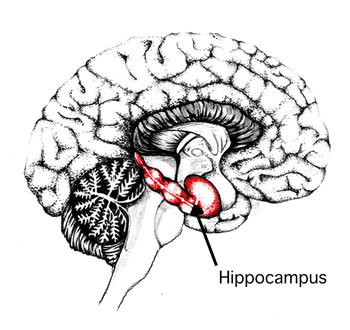
(From Hippocampus)
A six team, multi-laboratory effort including USC, the University of Kentucky and Wake Forest University have been working on different components of what is described as an artificial brain prosthesis. The hippocampus is an area of your brain that is important for the formation of memories; it re-encodes short-term memory so it can be stored as long-term memory. Memory disorders in aging and disease are associated with loss of function in this area; it is also often damaged as a result of head trauma, stroke and epilepsy. At present, there is no clinically efficacious treatment for a damaged hippocampus.
Professor Theodore w. Berger, director of the Center for Neural Engineering at USC, leads a team that has studied the re-encoding process in slices of hippocampus taken from rats and kept alive in nutrients. They stimulated the neurons and and studied the output patterns, and arrived at a set of equivalent mathematical functions.
Dr. John J. Granacki has been implementing these functions onto a microchip. When tested against slices of rat hippocampus, the chips are 95 percent accurate in producing the same output as live cells for a given input.
"If you were looking at the output right now, you wouldn't be able to tell the difference between the biological hippocampus and the microchip hippocampus," Berger said. "It looks like it's working."The next step is to work with live rats; they will deactivate the biological hippocampus and then implant the microchip. It is expected to take two or three years to create complete mathematical models of a rat hippocampus; monkey models will follow in a few more years. If all goes well, an silicon hippocampus for humans may be available within fifteen years.
The team will present their research this week at the annual Society for Neuroscience meeting in San Diego.
Science fiction fans will remember Gibson's work in Neuromancer; he referred to chips that could be inserted into a special socket that was surgically implanted in a user's brain. The chips were called "microsofts." See Wired for the original story.
Scroll down for more stories in the same category. (Story submitted 10/26/2004)
Follow this kind of news @Technovelgy.| Email | RSS | Blog It | Stumble | del.icio.us | Digg | Reddit |
Would
you like to contribute a story tip?
It's easy:
Get the URL of the story, and the related sf author, and add
it here.
Comment/Join discussion ( 3 )
Related News Stories - (" Medical ")
3D Printed Organs From Space
'For a while your colonists will have to come up to the [orbital] Hospital...'
Health Kiosk Has No Human Doctor
'The electronic body analyzer had been developed...' - Michael Crichton, 1969.
NEO Brain Computer Interface (BCI)
'The remains of the lace took on the rough shape of a brain...' - Iain Banks, 2010.
MIT Computerized Bionic Leg Is Part Of The User
'The leg was to function, in a way, as a servo-mechanism operated by Larry’s brain, through the mediation of the electronic brain in the leg.' - Charles Recour, 1949.
Technovelgy (that's tech-novel-gee!) is devoted to the creative science inventions and ideas of sf authors. Look for the Invention Category that interests you, the Glossary, the Invention Timeline, or see what's New.

Science Fiction
Timeline
1600-1899
1900-1939
1940's 1950's
1960's 1970's
1980's 1990's
2000's 2010's
Current News
'If Anyone Is Watching Earth...'
'Our study of your race has convinced us that you are not fitted to leave your planet in the present state of your civilization.'
Epirus High-Power Microwave Defeats Drones
'...the spreading beam of the deranging ray struck them, and Then one toppled and fell. Then another.'
Cloud Of Space Rubbish From China's Long March Rocket
'Within seconds the material was spread out over fifty yards, in a matter of hours it might occupy several cubic miles of space...'
Biomimetic Tendons From Rochu Robotics
'... the curious parallelism to animal motions.'
Living Human Neuron Biological Compute Rack
'The men are dead, but their acquired wisdom lives on and I am the beneficiary.'
Martha Stewart Approves Ojai 'Living Room On Wheels'
'Young people found the driverless car admirable for petting.'
ESA's Draco To Study Heat Of Reentry
'...a synthetic which air-friction would erode.'
Buy A Galaxy? Maybe Start Smaller
'The sky is the limit' just got higher.
The United States Space Academy Is Official
'Is our orbit to Space Academy clear?'
Is There A Global Problem With Who Is Having Children?
'After twenty generations of shillyshallying...'
You Will Eat The Cookies Made From Plastic...
'Our planes are going to start bringing in bales of discarded plastics...'
It's A Giant Robot! You Reporters Have Been Warned!
'... completely forgetting the ship at sight of the awesome figure and great head of the giant Gaut...'
Birds Learn To Sing Pictures ala Frank Herbert's Distrans
'We will fight in the time of fighting.'
ElectionSim: China's 'Ender's Game' Battle Sim, Or Lem's 'Kingdom In A Box'?
'So, Ender, we will now begin your education.'
Tactile Skin Supplier Map
'What strange sensitivity! What an amazing development of science was manifested in every move and act and word of this Robot!'
Flock Stymied By 'Adversarial Fashion'
'Forget the head atop it, the legs below, feet, arms, hands. It compels erasure.'

