
Science Fiction
Dictionary
A B C D E F G H I J K L M N O P Q R S T U V W X Y Z

 |
SLAM from CSAIL Lets Robots Explore Autonomously

SLAM (Simultaneous Localization and Mapping) is a new system under development by the folks at CSAIL (Computer Science and Artificial Intelligence Laboratory, at MIT). The idea is to allow robots to navigate through varied environments without input from humans; SLAM lets the robots build and continuously update a three-dimensional map of their surroundings.
The SLAM system has been implemented in a Willow Garage PR2 robot using Microsoft's Kinnect. PR2 is an impressive research robot; read more about it in these stories:
But MIT's CSAIL researchers are not just doing this for robots; they hope that blind humans may one day be able to make use of a similar system to explore more confidently.
Amazing video shows robot mapping its environment supported by Google's cloud services.
PR2 robot shows the future of robotic helpers in this laundry-folding video.
Earlier experiment in which a robot roams an office alone.
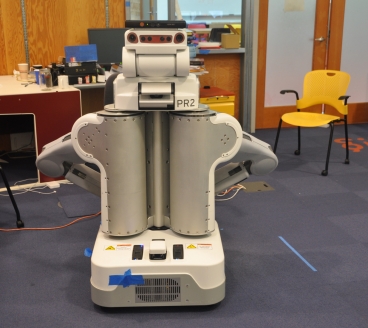
(PR2 using SLAM at CSAIL)
To explore unknown environments, robots need to be able to map them as they move around — estimating the distance between themselves and nearby walls, for example — and to plan a route around any obstacles, says Maurice Fallon, a research scientist at CSAIL who is developing these systems alongside John J. Leonard, professor of mechanical and ocean engineering, and graduate student Hordur Johannsson.But while a large amount of research has been devoted to developing one-off maps that robots can use to navigate around an area, these systems cannot adjust to changes in the surroundings over time, Fallon says: “If you see objects that were not there previously, it is difficult for a robot to incorporate that into its map.”
The new approach, based on a technique called Simultaneous Localization and Mapping (SLAM), will allow robots to constantly update a map as they learn new information over time, he says. The team has previously tested the approach on robots equipped with expensive laser-scanners, but in a paper to be presented this May at the International Conference on Robotics and Automation in St. Paul, Minn., they have now shown how a robot can locate itself in such a map with just a low-cost Kinect-like camera.
As the robot travels through an unexplored area, the Kinect sensor’s visible-light video camera and infrared depth sensor scan the surroundings, building up a 3-D model of the walls of the room and the objects within it. Then, when the robot passes through the same area again, the system compares the features of the new image it has created — including details such as the edges of walls, for example — with all the previous images it has taken until it finds a match.
At the same time, the system constantly estimates the robot’s motion, using on-board sensors that measure the distance its wheels have rotated. By combining the visual information with this motion data, it can determine where within the building the robot is positioned. Combining the two sources of information allows the system to eliminate errors that might creep in if it relied on the robot’s on-board sensors alone, Fallon says.
Once the system is certain of its location, any new features that have appeared since the previous picture was taken can be incorporated into the map by combining the old and new images of the scene, Fallon says.
From MIT.
Scroll down for more stories in the same category. (Story submitted 2/16/2012)
Follow this kind of news @Technovelgy.| Email | RSS | Blog It | Stumble | del.icio.us | Digg | Reddit |
Would
you like to contribute a story tip?
It's easy:
Get the URL of the story, and the related sf author, and add
it here.
Comment/Join discussion ( 0 )
Related News Stories - (" Robotics ")
Epirus High-Power Microwave Defeats Drones
'...the spreading beam of the deranging ray struck them, and Then one toppled and fell. Then another.' - Ray Cummings, 1931.
It's A Giant Robot! You Reporters Have Been Warned!
'... completely forgetting the ship at sight of the awesome figure and great head of the giant Gaut...'
Tactile Skin Supplier Map
'What strange sensitivity! What an amazing development of science was manifested in every move and act and word of this Robot!' - Ray Cummings, 1931.
Robot Bees 3D Printed By Festo
'At first I was struck by the large size of these bees..' - Ernst Junger, 1957.
Technovelgy (that's tech-novel-gee!) is devoted to the creative science inventions and ideas of sf authors. Look for the Invention Category that interests you, the Glossary, the Invention Timeline, or see what's New.

Science Fiction
Timeline
1600-1899
1900-1939
1940's 1950's
1960's 1970's
1980's 1990's
2000's 2010's
Current News
'If Anyone Is Watching Earth...'
'Our study of your race has convinced us that you are not fitted to leave your planet in the present state of your civilization.'
Epirus High-Power Microwave Defeats Drones
'...the spreading beam of the deranging ray struck them, and Then one toppled and fell. Then another.'
Cloud Of Space Rubbish From China's Long March Rocket
'Within seconds the material was spread out over fifty yards, in a matter of hours it might occupy several cubic miles of space...'
Biomimetic Tendons From Rochu Robotics
'... the curious parallelism to animal motions.'
Living Human Neuron Biological Compute Rack
'The men are dead, but their acquired wisdom lives on and I am the beneficiary.'
Martha Stewart Approves Ojai 'Living Room On Wheels'
'Young people found the driverless car admirable for petting.'
ESA's Draco To Study Heat Of Reentry
'...a synthetic which air-friction would erode.'
Buy A Galaxy? Maybe Start Smaller
'The sky is the limit' just got higher.
The United States Space Academy Is Official
'Is our orbit to Space Academy clear?'
Is There A Global Problem With Who Is Having Children?
'After twenty generations of shillyshallying...'
You Will Eat The Cookies Made From Plastic...
'Our planes are going to start bringing in bales of discarded plastics...'
It's A Giant Robot! You Reporters Have Been Warned!
'... completely forgetting the ship at sight of the awesome figure and great head of the giant Gaut...'
Birds Learn To Sing Pictures ala Frank Herbert's Distrans
'We will fight in the time of fighting.'
ElectionSim: China's 'Ender's Game' Battle Sim, Or Lem's 'Kingdom In A Box'?
'So, Ender, we will now begin your education.'
Tactile Skin Supplier Map
'What strange sensitivity! What an amazing development of science was manifested in every move and act and word of this Robot!'
Flock Stymied By 'Adversarial Fashion'
'Forget the head atop it, the legs below, feet, arms, hands. It compels erasure.'

