
Science Fiction
Dictionary
A B C D E F G H I J K L M N O P Q R S T U V W X Y Z

 |
Launch Ring Magnetic Launch System By LaunchPoint

The Launch Ring, a vast circle of superconducting magnets capable of hurling satellites and other cargo into space, is the subject of a new two-year study financed by the USAF. The study will be carried out by LaunchPont Technologies, based in Goleta, California. The study will be led by James Fiske, who has done advanced work in designing maglev (magnetic levitation) freight transportation systems.
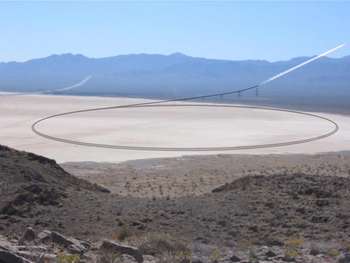
(LaunchPoint Magnetic launch ring concept drawing)
The Launch Ring will be similar in some ways to the enormous particle accelerators already in use. Most importantly, the device will (as its name implies) use a circular track, rather than the straight track considered in earlier designs (not to mention being considered in early science fiction novels).
The system would work by gradually accelerating a sled with a cone-shaped shell containing the cargo to a speed of ten kilometers per second. The shell would then separate from its sled and slide into a side tunnel angled at thirty degrees upward. The cone would emerge from the tunnel with a net speed of about eight kilometers per second, sufficient to achieve orbit. The shell would also contain some fuel for trajectory adjustment and placement in a proper orbit.
One disadvantage would be the substantial acceleration forces encountered when circling the ring at speed - up to 2,000 g's. The company points out that the US military uses electronics in laser-guided artillery, which survive being fired out of guns at up to 20,000 g's.
Key to the proposed usefulness of the Launch Ring is the hoped-for low cost to orbit. The cost per pound to orbit is about $6,000 for the space shuttle; it is estimated that if the Launch Ring is used 300 times per year, the cost would be about $745 per pound.
If this study pans out, funding would be sought for a small 20-50 meter diameter model, which would take at least four years to build. Obviously, we won't be launching payloads this way for quite some time, but this is a good first step.
Science fiction writer Robert Heinlein also thought about the concept of a similar launching device. In his novel The Moon is a Harsh Mistress, published in 1966, he wrote about an escape-speed induction catapult built on the Moon. In the novel, the Loonies have this advice for a similar device to built on Earth:
"...But the site must be a high mountain. It's that air pressure you spoke of, or air density. The catapult head should be at as high altitude as feasible but the ejection end, where the load travels over eleven kilometers per second, must be in air so thin that it approaches vacuum. Which calls for a very high mountain. Take the peak Nanda Devi, around four hundred kilometers from here. It has a railhead sixty kilometers from it and a road almost to its base. It is eight thousand meters high. I don't know that Nanda Devi is ideal. It is simply a possible site with good logistics; the ideal site would have to be selected by Terran engineers."
"A higher mountain would be better?"
"Oh, yes, sir!" I assured him. "A higher mountain would be preferred over one nearer the equator. The catapult can be designed to make up for loss in free ride from Earth's rotation. The difficult thing is to avoid so far as possible this pesky thick atmosphere... The length of an escape-speed catapult is determined by the acceleration. We think--or the computer calculates--that an acceleration of twenty gravities is about optimum. For Earth's escape speed this requires a catapult three hundred twenty-three kilometers in length.
(Read more about Heinlein's escape-speed induction catapult)
Read more about the Launch Ring and visit the LaunchPoint magnetic satellite launch system page. Thanks to Baja for writing in with the tip on the story.
Scroll down for more stories in the same category. (Story submitted 10/6/2006)
Follow this kind of news @Technovelgy.| Email | RSS | Blog It | Stumble | del.icio.us | Digg | Reddit |
Would
you like to contribute a story tip?
It's easy:
Get the URL of the story, and the related sf author, and add
it here.
Comment/Join discussion ( 4 )
Related News Stories - (" Space Tech ")
'If Anyone Is Watching Earth...'
'Our study of your race has convinced us that you are not fitted to leave your planet in the present state of your civilization.' - Arthur C. Clarke, 1946.
Cloud Of Space Rubbish From China's Long March Rocket
'Within seconds the material was spread out over fifty yards, in a matter of hours it might occupy several cubic miles of space...'
ESA's Draco To Study Heat Of Reentry
'...a synthetic which air-friction would erode.' - EE Doc Smith, 1934.
The United States Space Academy Is Official
'Is our orbit to Space Academy clear?' - Carey Rockwell
Technovelgy (that's tech-novel-gee!) is devoted to the creative science inventions and ideas of sf authors. Look for the Invention Category that interests you, the Glossary, the Invention Timeline, or see what's New.

Science Fiction
Timeline
1600-1899
1900-1939
1940's 1950's
1960's 1970's
1980's 1990's
2000's 2010's
Current News
'If Anyone Is Watching Earth...'
'Our study of your race has convinced us that you are not fitted to leave your planet in the present state of your civilization.'
Epirus High-Power Microwave Defeats Drones
'...the spreading beam of the deranging ray struck them, and Then one toppled and fell. Then another.'
Cloud Of Space Rubbish From China's Long March Rocket
'Within seconds the material was spread out over fifty yards, in a matter of hours it might occupy several cubic miles of space...'
Biomimetic Tendons From Rochu Robotics
'... the curious parallelism to animal motions.'
Living Human Neuron Biological Compute Rack
'The men are dead, but their acquired wisdom lives on and I am the beneficiary.'
Martha Stewart Approves Ojai 'Living Room On Wheels'
'Young people found the driverless car admirable for petting.'
ESA's Draco To Study Heat Of Reentry
'...a synthetic which air-friction would erode.'
Buy A Galaxy? Maybe Start Smaller
'The sky is the limit' just got higher.
The United States Space Academy Is Official
'Is our orbit to Space Academy clear?'
Is There A Global Problem With Who Is Having Children?
'After twenty generations of shillyshallying...'
You Will Eat The Cookies Made From Plastic...
'Our planes are going to start bringing in bales of discarded plastics...'
It's A Giant Robot! You Reporters Have Been Warned!
'... completely forgetting the ship at sight of the awesome figure and great head of the giant Gaut...'
Birds Learn To Sing Pictures ala Frank Herbert's Distrans
'We will fight in the time of fighting.'
ElectionSim: China's 'Ender's Game' Battle Sim, Or Lem's 'Kingdom In A Box'?
'So, Ender, we will now begin your education.'
Tactile Skin Supplier Map
'What strange sensitivity! What an amazing development of science was manifested in every move and act and word of this Robot!'
Flock Stymied By 'Adversarial Fashion'
'Forget the head atop it, the legs below, feet, arms, hands. It compels erasure.'

