
Science Fiction
Dictionary
A B C D E F G H I J K L M N O P Q R S T U V W X Y Z

 |
Starfish Robot Shows Robotic Introspection And Self-Modeling

A new four-legged robot can automatically synthesize a predictive model of its own topology (where and how its body parts are connected), and then successfully move around. It can also use this "proprioceptive" sense to determine if a component has been damaged, and then model new movements that take the damage into account.
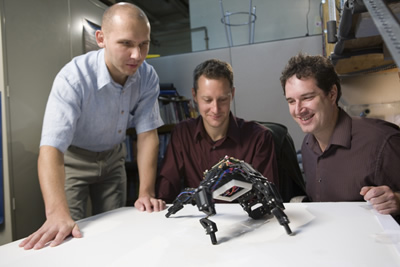
(Starfish robot and friends [L->R, Zykov, Bongard, Lipson])
In their article, Josh Bongard, Victor Zykov, and Hod Lipson describe their experiment:
We demonstrate, both computationally and experimentally, how a legged robot automatically synthesizes a predictive model of its own topology (where and how its body parts are connected) through limited yet self-directed interaction with its environment, and then uses this model to synthesize successful new locomotive behavior before and after damage. The legged robot learned how to move forward based on only 16 brief self-directed interactions with its environment. These interactions were unrelated to the task of locomotion, driven only by the objective of disambiguating competing internal models. These findings may help develop more robust robotics, as well as shed light on the relation between curiosity and cognition in animals and humans...
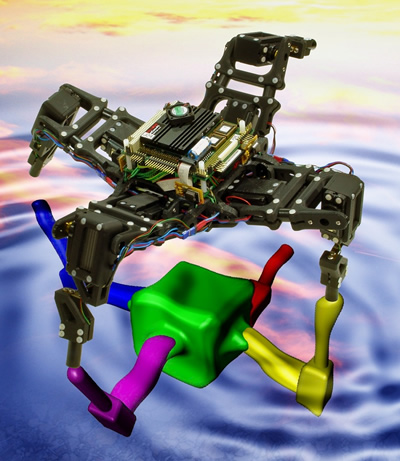
(Starfish robot introspects, modeling itself)
If the robot is damaged, it can sense the problem and attempt to compensate. The robot has tilt and angle sensors in all of its joints; readings from these sensors are used by the robot to create a self-image. If sensors indicate that a part is missing or damaged, it changes its image of itself and moves on.
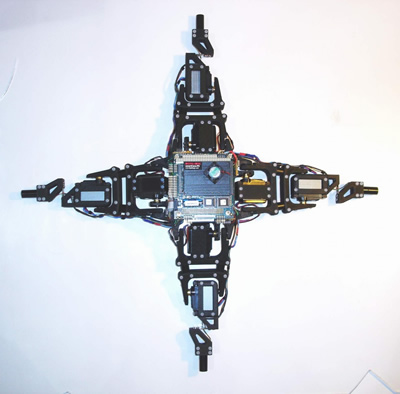
(Starfish robot top view)
As for sf references, everybody remembers the HAL-9000 unit that ran the spaceship in 2001: A Space Odyssey. HAL was also able to sense problems in the ship and then get one if its servants (the human astronauts) to install new components, if necessary.
Despite their achievement, the researchers remain modest in the face of nature. "We never officially named it, but we usually refer to it as the Starfish robot, even though a real starfish has five rather than four legs," said lead researcher Josh Bongard, now at the University of Vermont. "Also, a real starfish is much better than our robot at recovering from injury, because it can actually regrow its legs."
Update 24-Nov-2006: See a remarkable Starfish robot video.
Update 23-Sep-2022: An interesting prediction of this idea in the 1949 short story Unforeseen, by Roger P. Graham, published by Fantastic Adventures in 1949:
...it will take at least two years to synthesize their minds to the point where they are as capable as an adult.”“Two years!” came a chorus of voices. “That long?”
“I think that a remarkably short period,” Horace said with his first show of temper. “After all they start out like a newborn babe and have to discover their hands, feet, and other parts of their bodies. They have to learn just like a human baby, except that they are full size to start with.
(Read more about robot introspection)
End update.
Take look as some earlier work by Lipson and Zykov et al in this article - Self-Replicating Modular Robots. More materials here, including a video, as well as here.| Thanks to an anonymous reader who suggested this article.
Scroll down for more stories in the same category. (Story submitted 11/17/2006)
Follow this kind of news @Technovelgy.| Email | RSS | Blog It | Stumble | del.icio.us | Digg | Reddit |
Would
you like to contribute a story tip?
It's easy:
Get the URL of the story, and the related sf author, and add
it here.
Comment/Join discussion ( 4 )
Related News Stories - (" Robotics ")
Epirus High-Power Microwave Defeats Drones
'...the spreading beam of the deranging ray struck them, and Then one toppled and fell. Then another.' - Ray Cummings, 1931.
It's A Giant Robot! You Reporters Have Been Warned!
'... completely forgetting the ship at sight of the awesome figure and great head of the giant Gaut...'
Tactile Skin Supplier Map
'What strange sensitivity! What an amazing development of science was manifested in every move and act and word of this Robot!' - Ray Cummings, 1931.
Robot Bees 3D Printed By Festo
'At first I was struck by the large size of these bees..' - Ernst Junger, 1957.
Technovelgy (that's tech-novel-gee!) is devoted to the creative science inventions and ideas of sf authors. Look for the Invention Category that interests you, the Glossary, the Invention Timeline, or see what's New.

Science Fiction
Timeline
1600-1899
1900-1939
1940's 1950's
1960's 1970's
1980's 1990's
2000's 2010's
Current News
'If Anyone Is Watching Earth...'
'Our study of your race has convinced us that you are not fitted to leave your planet in the present state of your civilization.'
Epirus High-Power Microwave Defeats Drones
'...the spreading beam of the deranging ray struck them, and Then one toppled and fell. Then another.'
Cloud Of Space Rubbish From China's Long March Rocket
'Within seconds the material was spread out over fifty yards, in a matter of hours it might occupy several cubic miles of space...'
Biomimetic Tendons From Rochu Robotics
'... the curious parallelism to animal motions.'
Living Human Neuron Biological Compute Rack
'The men are dead, but their acquired wisdom lives on and I am the beneficiary.'
Martha Stewart Approves Ojai 'Living Room On Wheels'
'Young people found the driverless car admirable for petting.'
ESA's Draco To Study Heat Of Reentry
'...a synthetic which air-friction would erode.'
Buy A Galaxy? Maybe Start Smaller
'The sky is the limit' just got higher.
The United States Space Academy Is Official
'Is our orbit to Space Academy clear?'
Is There A Global Problem With Who Is Having Children?
'After twenty generations of shillyshallying...'
You Will Eat The Cookies Made From Plastic...
'Our planes are going to start bringing in bales of discarded plastics...'
It's A Giant Robot! You Reporters Have Been Warned!
'... completely forgetting the ship at sight of the awesome figure and great head of the giant Gaut...'
Birds Learn To Sing Pictures ala Frank Herbert's Distrans
'We will fight in the time of fighting.'
ElectionSim: China's 'Ender's Game' Battle Sim, Or Lem's 'Kingdom In A Box'?
'So, Ender, we will now begin your education.'
Tactile Skin Supplier Map
'What strange sensitivity! What an amazing development of science was manifested in every move and act and word of this Robot!'
Flock Stymied By 'Adversarial Fashion'
'Forget the head atop it, the legs below, feet, arms, hands. It compels erasure.'

