
Science Fiction
Dictionary
A B C D E F G H I J K L M N O P Q R S T U V W X Y Z

 |
Self-Healing Circuits From Carnegie Mellon

Researchers at Carnegie Mellon University have created a self-healing material that spontaneously repairs itself under extreme mechanical damage.
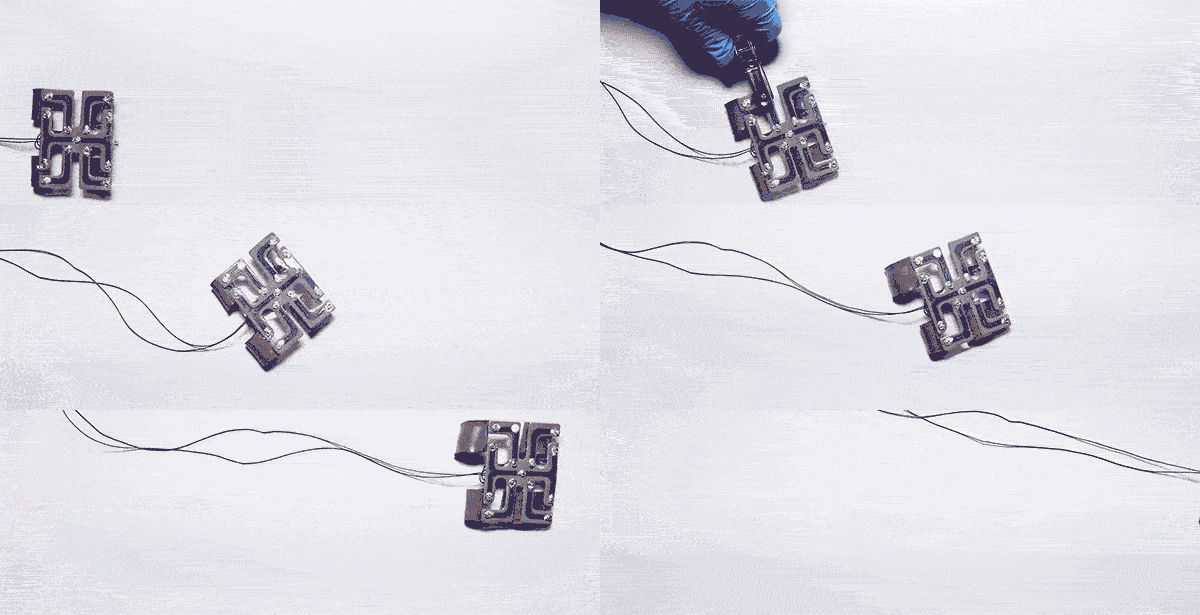
(Carnegie Mellon University College of Engineering)
This soft-matter composite material is composed of liquid metal droplets suspended in a soft elastomer. When damaged, the droplets rupture to form new connections with neighboring droplets and reroute electrical signals without interruption. Circuits produced with conductive traces of this material remain fully and continuously operational when severed, punctured, or had material removed.“Other research in soft electronics has resulted in materials that are elastic and deformable, but still vulnerable to mechanical damage that causes immediate electrical failure,” said Carmel Majidi, an associate professor of mechanical engineering. “The unprecedented level of functionality of our self-healing material can enable soft-matter electronics and machines to exhibit the extraordinary resilience of soft biological tissue and organisms.”
Applications for its use include bio-inspired robotics, human-machine interaction, and wearable computing. Because the material also exhibits high electrical conductivity that does not change when stretched, it is ideal for use in power and data transmission. Think of a first responder robot that can rescue humans during an emergency without sustaining damage, a health-monitoring device on an athlete during rigorous training, or an inflatable structure that can withstand environmental extremes on Mars.
Science fiction authors initiated the idea of self-healing materials long ago. For example, consider the self-healing houses from brilliant writer JG Ballard's 1962 story The Thousand Dreams of Stellavista.
Even better, the self-healing plastic from Golden Age great Raymond Z. Gallun's 1951 short story Asteroid of Fear, which was perfect for asteroid greenhouses:
But the wide roof was all the way up, now—intact. It made a great, squarish bubble, the skin of which [a 'transparent, wire-strengthened plastic '] was specially treated to stop the hard and dangerous part of the ultra-violet rays of the sun, and also the lethal portion of the cosmic rays. It even had an inter-skin layer of gum that could seal the punctures that grain-of-sand-sized meteors might make.
Heal your own knowledge gap about these unique materials:
-
- Self-Repairing Aircraft Mimic Borg Cubes
- Bendable, Self-Healing Concrete
- Smart, Self-Healing Hydrogels
- Self-Healing Materials - Microencapsulated or Microvascular
- Self-Healing Polymer Works Without Catalyst
- Living Concrete Repairs Itself
- Self-Healing Materials For Spacecraft
- Self-Adapting Composite Heals Itself
Via Carnegie Mellon.
Scroll down for more stories in the same category. (Story submitted 5/19/2018)
Follow this kind of news @Technovelgy.| Email | RSS | Blog It | Stumble | del.icio.us | Digg | Reddit |
Would
you like to contribute a story tip?
It's easy:
Get the URL of the story, and the related sf author, and add
it here.
Comment/Join discussion ( 0 )
Related News Stories - (" Material ")
'Mooncrete' Lunar Regolith Concrete (LRC)
'And here they began to build...' - William Gibson, 1988.
Harvard Metamaterials Change Structure Instantly
'Annealed in any shape for a time, and codified, the structure of that shape is retained down to the molecules.' - Samuel R. Delany
Nano-Chainmail 2D Mechanically Interlocked Polymer
'Nemourlon armor of reasonable weight resists penetration by most fragments and any bullet that is not both reasonably heavy and fairly high-velocity.' - Jerry Pournelle, 1976.
Goldene - A Two-Dimensional Sheet Of Gold One Atom Thick
'Hasan always pitched a Gauzy - a one-molecule-layer tent, opaque, feather-light, and very tough.' - Roger Zelazny, 1966.
Technovelgy (that's tech-novel-gee!) is devoted to the creative science inventions and ideas of sf authors. Look for the Invention Category that interests you, the Glossary, the Invention Timeline, or see what's New.

Science Fiction
Timeline
1600-1899
1900-1939
1940's 1950's
1960's 1970's
1980's 1990's
2000's 2010's
Current News
'If Anyone Is Watching Earth...'
'Our study of your race has convinced us that you are not fitted to leave your planet in the present state of your civilization.'
Epirus High-Power Microwave Defeats Drones
'...the spreading beam of the deranging ray struck them, and Then one toppled and fell. Then another.'
Cloud Of Space Rubbish From China's Long March Rocket
'Within seconds the material was spread out over fifty yards, in a matter of hours it might occupy several cubic miles of space...'
Biomimetic Tendons From Rochu Robotics
'... the curious parallelism to animal motions.'
Living Human Neuron Biological Compute Rack
'The men are dead, but their acquired wisdom lives on and I am the beneficiary.'
Martha Stewart Approves Ojai 'Living Room On Wheels'
'Young people found the driverless car admirable for petting.'
ESA's Draco To Study Heat Of Reentry
'...a synthetic which air-friction would erode.'
Buy A Galaxy? Maybe Start Smaller
'The sky is the limit' just got higher.
The United States Space Academy Is Official
'Is our orbit to Space Academy clear?'
Is There A Global Problem With Who Is Having Children?
'After twenty generations of shillyshallying...'
You Will Eat The Cookies Made From Plastic...
'Our planes are going to start bringing in bales of discarded plastics...'
It's A Giant Robot! You Reporters Have Been Warned!
'... completely forgetting the ship at sight of the awesome figure and great head of the giant Gaut...'
Birds Learn To Sing Pictures ala Frank Herbert's Distrans
'We will fight in the time of fighting.'
ElectionSim: China's 'Ender's Game' Battle Sim, Or Lem's 'Kingdom In A Box'?
'So, Ender, we will now begin your education.'
Tactile Skin Supplier Map
'What strange sensitivity! What an amazing development of science was manifested in every move and act and word of this Robot!'
Flock Stymied By 'Adversarial Fashion'
'Forget the head atop it, the legs below, feet, arms, hands. It compels erasure.'

