
Science Fiction
Dictionary
A B C D E F G H I J K L M N O P Q R S T U V W X Y Z

 |
Moonquake-Proof Moonbases Needed?

Moonquake-proof habitats? Clive R. Neal, associate professor of civil engineering and geological sciences at the University of Notre Dame, believes that special construction for moonbases may be necessary if we persist in our goal to return to the Moon.
Information about moonquakes comes from the seismometers placed on the Moon by Apollo astronauts from 1969 through 1972. The instruments placed by the Apollo 12, 14, 15 and 16 functioned perfectly until switched off in 1977.
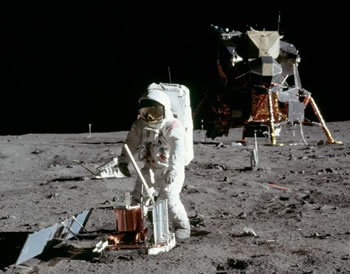
(Buzz Aldrin deploys a seismometer in the Sea of Tranquility)
According to NASA, there are at least four different kinds of moonquakes:
- deep moonquakes (~700 km below the surface, probably caused by tidal in origin)
- meteorites impact vibrations
- thermal quakes (the frigid lunar crust expands sunlight returns after the two week lunar night)
- shallow moonquakes (20 or 30 kilometers below the surface)
Little is known about the causes, or the distribution, of shallow moonquakes. One possible explanation is that relatively young craters may slump. Neal and his colleagues are proposing that a network of 12 seismometers be placed around the moon to gather data; this would be part of the larger plan to find safe lunar bases.
So, who was first to work on the problem of moonquake-proof habitats? Robert Heinlein is a good candidate: he made some suggestions in his 1948 story Gentlemen, Be Seated, which takes place on the Moon as a new colony is expanding. First, he identifies the problem:
"Every engineering job has its own hazards," he insisted, "and its advantages, too. Our men don't get malaria and they don't have to watch out for rattlesnakes...""Okay, okay," I interrupted, "so the place is safe... So you keep unnecessary airlocks. Why?"
He hesitated before he answered, "Quakes."
Quakes. Earthquakes-moonquakes, I mean.
(Read more about moonquake-proof habitats)
One solution that is offered is that of extra airlocks; by compartmentalizing your walkway or habitat, you can cut your losses. The second suggestion is that of flexible joints:
"Show him a flexible joint," Knowles directed. "Coming up." We paused half-way down the tunnel and Konski pointed to a ring segment that ran completely around the tubular tunnel. "We put in a flex joint every hundred feet. It's glass cloth, gasketed onto the two steel sections it joins. Gives the tunnel a certain amount of springiness."
(Read more about moonquake-proof habitats)
As a final suggestion, to be used during emergencies when relatively small leaks might result from quakes (or other causes), Heinlein suggests the use of "tag-alongs:"
There were perhaps a dozen bladder-like objects in the tunnel, the size and shape of toy balloons. They seemed to displace exactly their own weight of air; they floated without displaying much tendency to rise or settle. Konski batted one out of his way and answered me before I could ask."This piece of tunnel was pressurized today," he told me.
"These tag-alongs search out stray leaks. They're sticky inside. They get sucked up against a leak, break, and the goo gets sucked in, freezes and seals the leak."
(Read more about tag-alongs)
And beyond the Moon? One of the seismometers carried to Mars by the U.S. Viking landers during the mid-1970's remained operational. Only one possible marsquake was detected in 546 Martian days. The Mars Global Surveyor spacecraft detected what appeared to be changes to the Martian surface; Michael Meyer, chief scientist for the mission, speculated that the changes might have been caused by marsquakes.
Read more about moonquakes at NASA and Space.com. Thanks to Troy and Fred Kiesche for contributing the tip on this story.
Scroll down for more stories in the same category. (Story submitted 3/16/2006)
Follow this kind of news @Technovelgy.| Email | RSS | Blog It | Stumble | del.icio.us | Digg | Reddit |
Would
you like to contribute a story tip?
It's easy:
Get the URL of the story, and the related sf author, and add
it here.
Comment/Join discussion ( 1 )
Related News Stories - (" Space Tech ")
'If Anyone Is Watching Earth...'
'Our study of your race has convinced us that you are not fitted to leave your planet in the present state of your civilization.' - Arthur C. Clarke, 1946.
Cloud Of Space Rubbish From China's Long March Rocket
'Within seconds the material was spread out over fifty yards, in a matter of hours it might occupy several cubic miles of space...'
ESA's Draco To Study Heat Of Reentry
'...a synthetic which air-friction would erode.' - EE Doc Smith, 1934.
The United States Space Academy Is Official
'Is our orbit to Space Academy clear?' - Carey Rockwell
Technovelgy (that's tech-novel-gee!) is devoted to the creative science inventions and ideas of sf authors. Look for the Invention Category that interests you, the Glossary, the Invention Timeline, or see what's New.

Science Fiction
Timeline
1600-1899
1900-1939
1940's 1950's
1960's 1970's
1980's 1990's
2000's 2010's
Current News
'If Anyone Is Watching Earth...'
'Our study of your race has convinced us that you are not fitted to leave your planet in the present state of your civilization.'
Epirus High-Power Microwave Defeats Drones
'...the spreading beam of the deranging ray struck them, and Then one toppled and fell. Then another.'
Cloud Of Space Rubbish From China's Long March Rocket
'Within seconds the material was spread out over fifty yards, in a matter of hours it might occupy several cubic miles of space...'
Biomimetic Tendons From Rochu Robotics
'... the curious parallelism to animal motions.'
Living Human Neuron Biological Compute Rack
'The men are dead, but their acquired wisdom lives on and I am the beneficiary.'
Martha Stewart Approves Ojai 'Living Room On Wheels'
'Young people found the driverless car admirable for petting.'
ESA's Draco To Study Heat Of Reentry
'...a synthetic which air-friction would erode.'
Buy A Galaxy? Maybe Start Smaller
'The sky is the limit' just got higher.
The United States Space Academy Is Official
'Is our orbit to Space Academy clear?'
Is There A Global Problem With Who Is Having Children?
'After twenty generations of shillyshallying...'
You Will Eat The Cookies Made From Plastic...
'Our planes are going to start bringing in bales of discarded plastics...'
It's A Giant Robot! You Reporters Have Been Warned!
'... completely forgetting the ship at sight of the awesome figure and great head of the giant Gaut...'
Birds Learn To Sing Pictures ala Frank Herbert's Distrans
'We will fight in the time of fighting.'
ElectionSim: China's 'Ender's Game' Battle Sim, Or Lem's 'Kingdom In A Box'?
'So, Ender, we will now begin your education.'
Tactile Skin Supplier Map
'What strange sensitivity! What an amazing development of science was manifested in every move and act and word of this Robot!'
Flock Stymied By 'Adversarial Fashion'
'Forget the head atop it, the legs below, feet, arms, hands. It compels erasure.'

